
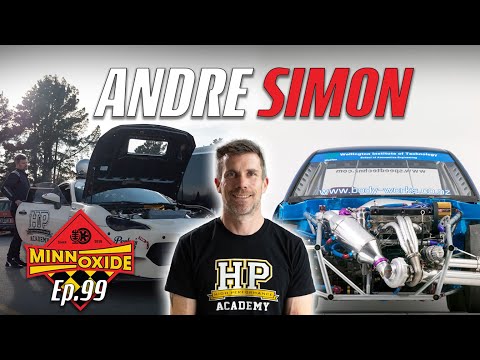
148. Bathurst 6 Hour Endurance Race, Tuning and Modifying cars, Builds w/ Andre Simon
Guest
Summary
Chapters
- 00:00:00 Intro - Who is Andre and what is HPA
- 00:08:27 Growing the business
- 00:19:29 Thrilling Endurance Race at Mount Panorama
- 00:22:31 How iRacing and SIMS help prepare for racing
- 00:31:50 Automotive Projects
- 00:36:33 Creating Engaging Automotive Content
- 00:41:00 Drag Racing Records
- 00:45:29 Drag Racing at Meremere Dragstrip
- 00:54:35 Managing Engine Safety and Performance in Street Cars
- 01:04:02 Reliability Challenges of High Horsepower Cars
- 01:08:17 The Rise of Affordable High-Powered EVs
- 01:12:55 Subarus and Knocking
- 01:21:53 ECU Differences, Traction and power management strategies
- 01:35:15 Converting Ferrari to a Manual Transmission
- 01:39:47 Upcoming Motorcycle and Powersports Courses
- 01:44:01 Common Misconceptions in Aerodynamics
Full Transcript
At the time, I was pretty well known because of the drag racing success we'd had, so people wanted to double down on showing off. Please don't, please don't. The reliability I expected out of a world record setting drag car is different to the reliability I hoped to achieve, but yet have not achieved in our endurance race car. And then what I'd expect for my daily drivers.
Hello ladies and gentlemen, welcome back to the Minnoxide podcast. I'm your host, Harris AKA Minnoxide, man of many automotive aspirations, and I'm here with my Ford Loving co-host, Dan. Yep. Mr. Gunnigaraj.
Feeling right at home, literally.
Yeah, literally at home. And today we are, it's been about a year since we've had this guest on. We are reconnecting with Andre Simon of High Performance Academy. Good to see you again, Andre.
Thanks for having me on. Has it been a year already? Time flies.
Coming up on it, I think we're at like 10 or 11 months at the moment, so I'm just trying to circle back with everybody we had on last year, so. But yeah, go ahead and tell, for any of the new listeners of the channel, just go ahead, tell people who it is you are, or who it is. We'll work on my English later. What it is you do, and we'll go from there.
All right, Andre, as already mentioned, I am one of the founders and technical director of High Performance Academy based here in New Zealand, Queenstown, New Zealand. We run an online training school, and essentially we teach people how to make cars go faster. We make a variety of training courses. We started in engine tuning, EFI tuning, then moved into engine building and wiring. But now we cover just about everything in the automotive scene. So driver education, 3D modelling and CAD, aerodynamics, the list is long. Even fabrication, and we'll branch you out into a whole bunch of different topics. So basically just trying to improve the level of knowledge out there in the automotive industry, and improve what guys and girls can do in their home workshop, showing that this stuff is absolutely not impossible.
So, you've been working on a number of things since then, and like me and Dan have signed up for your courses, which is, it's been fun to expand our knowledge, but you've said you've had a big bit of growth recently when we were talking off camera. What does that kind of look like? Because obviously you have a lot of motorsport based courses and such. What has that expansion been looking like? And we'll talk about the cars and stuff later, of course, but I figured to kick this off.
Yeah, I think the trajectory of HPA has kind of been, it started with Ben and myself, and that was 10 and a half years ago now we actually moved to Queenstown. We'd been running a couple of years before that, just kind of as a side hustle, proof of concept, see if it was going to work. And clearly it was going to. When we moved to Queenstown, it was just the two of us, and we'd kind of been a little bit burned on having staff with my last business. So we were pretty adamant that we were just going to run it, the two of us. And after, I would say it was probably only six months, we decided, hey, you know what, if this is going to have a chance of working, and we are going to give it a red hot crack and make it what it can be, we're going to need staff. So we sort of slowly expanded. It was all bootstrapped. We had no outside investment, so we just sort of grew as we could afford to. It's always kind of scary as well, taking on staff. We don't know initially if you can afford to pay them. Fortunately, that's always worked out for us. And every time we've expanded, it's just worked. I'm hoping that that continues. And we sort of got to a point where, I mean, for us, I guess it's never really been about chasing a financial target. It's really about the fact that we're passionate about the industry, we're passionate about sharing our knowledge and improving knowledge out there, so people can do more on their cars. But what we sort of ended up with is, you're making X top line revenue in a year. You're like, oh yeah, well, that's fine. We're getting by, everything's working. And you kind of just coast. And that's what we've sort of done. It's been like a step. You sort of got to that next step, you grow, and then we coast for a little bit. And then Ben and I will have a chat one time and say, hey, look, we could do this, this and this. There's demand for these other courses. So we look at what's needed, bring in some more talent and take another step up, and then we're sort of coasted. And I guess we've just had that same chat, maybe in the last six or nine months, like, hey, maybe we can take this up a notch and provide even more value. And there's also a whole range of courses that we've just constantly been asked for. And I guess to our detriment, it's gonna sound a little bit silly, but if I'm not really passionate about it, it probably hasn't happened. And one of our guys, Taz, who kind of mans our customer service, he's mad keen into dirt bikes, motor bikes in general, and adventure bikes. And he's constantly been on us, hey, we should definitely do some motorcycle courses. And like, yeah, it's just not really my jam, so it hasn't happened. And we also have a channel in our Slack, which is Customer Request, and it's pretty consistent over the years. Motorcycle content, motorcycle content. So finally we've relented, okay, that makes a lot of sense. And along with that comes power sports as well. So side by side market, jet ski, personal watercraft market, it's all kind of that same thing. A lot of it, there is overlap with our automotive courses. If we're looking at engine building or tuning, you know, an engine's an engine, there are some idiosyncrasies with the engine motor side of things. So we found a guy locally who is an absolute guru with all things motorcycle. He also is great on camera. So we're in the process of producing some courses with him. Along the same lines, we also realized that to steer the ship and have some constant sort of, someone needed to be there to filter Ben in my kind of random, crazy, hair brained ideas and sort of actually get them actionable and then hold people accountable. So we've also employed a general manager. He's only been here, I think, four weeks now, and he's been amazing. So he's kind of whipping everything into shape. More video stuff as well, because we're doing a lot more content, we're planning to do a lot more content this year on our in-house projects. And then we're also moving into composites. So we're about to release a basic composites course for the automotive industry. So stuff that people can do at home. I'm not talking here about pre-preg or even resin infusion in this basic course, just a wet layup that people can actually do themselves. And it's not that difficult, it's not that expensive, but you need to understand how.
Sure.
Top of that, general automotive maintenance as well. We know that as times get harder, it looks like a recession might just be around the corner. Obviously under those conditions, people don't have as much disposable income to throw at their cars and maybe going and getting your car serviced at your local shop is no longer an option. So we're going to come up with a more low level basic course, how to do oil changes, clutches, bleed your brakes, change brake pads, all of those basic things that are totally within the capabilities of any home enthusiast with a very basic tool set and a bit of a thirst for knowledge.
Sure.
So that kind of covers it, maybe? Yeah, there you go. That's the gist of it anyway. But big growth, I think we're probably taking our stuff from about 13 up to about 20 in the end.
Sure. So real quick, I had this question towards the beginning here. So we have a lot of automotive stuff when it comes to our questions, but I've actually had a lot of listeners reach out more curious on the business side of things. And a lot of shops kind of, and this can come from an HPA perspective or your shop perspective in the past, we have a lot of people where they're kind of stuck as a one man band or two or three people. At what point do you make that jump into getting more employees? Did you ever struggle with that yourself?
Every single time it has been terrifying, if I'm honest. If I go back to my original shop, which for those who don't know, for 13 years I only ran a workshop, performance workshop in New Zealand called Speed Tech Motorsport or STM for short. So we did all of the usual things that you'd expect, engine building, performance upgrades, and we had our in house dyno and tuning. And I started that as a one man band, and you sort of quickly get overwhelmed. You can't do all of the work. And the other thing with running a business as a one man band is you very quickly realise that you are, if you're lucky, able to spend maybe half of your day doing the thing that you're good at, that you love. And the rest of it is all of the other stuff that comes through with running a business, quoting jobs, answering the phone, talking to customers, ordering parts, taxes, invoicing, the list goes on, all the stuff that I absolutely did not enjoy. So you get to a point where it might make sense to pay someone to come in and do that, sort of be front of house. I bootstrapped that business as well. I didn't have any big dollar investment, and it was a case of growing as we went. So it was definitely a leap of faith, knowing that I'm committing to a wage bill every week, and will this person bring in more than I'm spending on them. I think a little bit of it just comes down to an understanding of where the business is going, how much demand you've got, and the confidence that you can deploy this person and make them make you money. And we've always had the backstop in mind of, in New Zealand, obviously, employment rules are different around the world. Here, we have a 90-day trial period for any full-time employee. So basically, within that 90 days, you can dismiss them for no cause. I would never want to do that unless I absolutely had to. I mean, to me, it's a commitment to my staff. You know, they have bills to pay as well, maybe families to feed, rent to pay, and that would be an absolute worst-case scenario. But otherwise, how that is, like an absolute emergency backstop, we can go back to how it was if this absolutely doesn't work. And fortunately, every time we have employed, it has worked. So that sort of starts to build your confidence. You know, I'm backing myself now. We can make smart business decisions. We can see the direction the business is going. We can see where there is demand, and we can fill that demand. Where that has been difficult in HPA is on-camera talent. That has been very tricky to find. We've been very fortunate with Connor who came on board doing our 3D modelling in CAD. Connor's really grown into that role. He's now exceptional on camera. And I think he's probably building up his own, what do I call it, a fan base? Maybe not a fan base as such.
I think it's fair though. I do like watching his content. I actually talked with Brad about having him on here in a few weeks potentially.
Yeah, I absolutely think he'd be great to chat to. And he just comes at it from a completely different perspective than me. Because he's very very smart and well educated as well, he's been really good at researching topics that maybe he doesn't have full domain expertise on, talking to the right people and bringing in experts to get the questions answered that we don't internally know. So he's been an excellent find. We've got Seth who very early days, the motorcycle power sports side of things, he was a stumble, we stumbled upon him actually because I blew up Ben's jet boat. He's got a 3.4 metre I think, a little mini alloy jet boat with a four cylinder, I think it's a Kawasaki jet ski engine in it. And I had the unfortunate experience of having that seize on me. Absolutely no fault of my own, I might point out. And Seth had been following me on Instagram and sort of reached out and he said I can fix that, I am a specialist on these. And it turned out to be 45 minutes up the road from us, one thing led to another, and I'm like hey, this guy is just like me, but in motorcycles. So he was a good find. Yeah, like I say, early days. Then we've just employed another guy out of Australia, Caleb, who's a specialist in motorsport wiring, and a really interesting sort of tail. It's kind of gone full circle because he took some of our wiring courses about eight or 10 years ago. So he's also really good with CNC, machining, CAD. I think so far, I haven't found anything he can't do, but we're also two weeks into having him with us. And then of course Mike McGuinness, who I know you guys are aware of from the US. We've been friends with Mike for years, and he's done our auto-trans tuning course, and we're most of the way through an emissions course as well, which is obviously becoming really important in the US. Yeah, I think that probably tops it off at the moment, but yeah. Don't know if I actually answered that question that well.
Well, I think you answered his question, and you answered the one I was gonna ask, which was you could find somebody that's absolutely best at what they do, but I was gonna ask, have you had anybody come in that's just been impossible on camera, and just goes fully Ricky Bobby on you or something, and doesn't know what to do with their hands?
Yes. So a couple of points I made there. A little tangent. For us, culture fit is infinitely more important than the actual skill set. Obviously, we're not gonna employ someone who just doesn't know what they're doing. That's a clear fail. But we really have to make sure that the cultural fit for HPA works. I've had a couple of experiences over the years where we employed people that just were a square peg and a round hole. And you watch just almost within days, if not weeks, the whole culture within the business kind of just changed and all obviously for the worse. And as soon as those people were removed from the business, overnight everything kind of bounced back. And seeing that first hand, yeah, the culture fit absolutely has to be right. We did, we had an interesting experience. We did a race driver education course with a local pro driver, Andrew Waite, who's excellent, very good friend of ours still to this day. And he was the pro driver at Highlands Motorsport Park, which is our local track. And he also does some local racing. He had been racing in what at the time was our top tier of motorsport in New Zealand, which was called the Super Tours, so like Australian V8 Supercar style of thing. And we employed him to write and front this course. And I was pretty confident, we didn't give him a trial, because I was pretty confident because he does a lot of work with the media in New Zealand anyway, and he's excellent. What we didn't factor in, and this is absolutely no disrespect to Andrew, it's just a learning curve for us and everyone else, we put him in the studio with the teleprompter, and he just could not read off the teleprompter. It was the weirdest thing. But that is of course a pretty unique skill, and now I realise that not everyone can do that, we need to test for that. So in the end, we just rejigged that course, and I ended up presenting it, and then to involve Andrew, he did the practical stuff, but to involve Andrew along the way, we'd also have an informal chat back and forth about the concept in the last module we talked about, and that worked exceptionally well. So I think in that respect, it's kind of about pivoting where we have to, to make something work.
The teleprompter thing was something to get used to. I've done that a handful of times, and it is a skill set, you're 100% correct in that.
It sounds easy, but I don't know how to do it.
It's amazing, sometimes I'll be presenting a course that I've written, and you're reading from the teleprompter, and you just start making up words. Why don't I just read what is in front of me? Why am I changing it? Or alternatively, you get to one word, and it's nothing unique or weird, and you just continually stumble on that one word for the next five minutes. Very frustrating, but what it does do is it creates a lot of great outtakes for my video team, who then turn that into embarrassing meme roles, and that's great too.
I've been loving, first of all, I'm getting hit with a bunch of your Spanish ads for some reason, but there's this, the deep breath one of you has been absolutely hysterical. It's all over my Facebook. It's the best advertisement you guys have done ever, but just figured I'd commend you on that. But okay.
Well, I have another quick follow up to that. So would you say staffing, what you're doing now versus having a performance shop is less stressful or same but different?
No, 100% less stressful. I think the stress level for running the performance workshop was, I've got these seven guys, I can't actually remember how many it was, but let's say it was seven, I've got to keep these guys busy. And all it would take is a slow month. And my most hated thing was sort of running around, trying to figure out how to keep these guys busy. And again, when you know that the margins are relatively tight, that doesn't really make a lot of sense financially either. So now, I mean, we make a digital product with no cost of sale. So it's obviously for that reason, a much more profitable business model than running a performance workshop. But there's literally no limit to the areas we can move into or what we can produce. So it's not very difficult to keep the video team, content team busy, for example.
Okay. Because you brought up the driving course, it just reminded me of your 86. Oh, you recently did that endurance race. How did that go for you?
Exceptional. Yeah, we entered a six-hour endurance race at Mount Panorama, Bathurst, which I can only imagine most people around the world are familiar with that racetrack, despite it being in the Southern Hemisphere. I would say it's one of the iconic tracks. And originally, I had nothing to do with this guy who, two people actually used to work for me in my old business. One of them I'm still very good friends with. They put together a deal to basically go over there and race. They purchased the car, the Toyota 86, that won its class the previous year. So something that had a run on the board. It was a proven performer. And halfway through, one of the three hit some financial snags and basically couldn't commit. So I got rung up as the alternate. Which wasn't very hard to twist my arm. We grew up here in New Zealand watching V8 Supercars and that iconic track. I remember watching the R32 Skyline GTR when that was running in the Group A championship and watching the likes of Peter Brock and all of those top drivers standing on the podium. So yeah, I'm in, I'm in, 100%. Probably two, 300 laps later on iRacing and the GR86 and we're over there. And yeah, I mean it's insane, that track. We're in a car with like, I don't know, 60 horsepower I guess. So going up Mountain Straight, which feels like it's just about vertical, feels like it's taking you about five minutes and you're getting passed by all these faster class cars. But once you've got that sort of thing wound up over the top of the mountain, winding between these walls, very unforgiving track, very little room for error. Yeah, it was absolutely insane. And we came away with second in class, which I think we went there with the aim of being competitive. But since that car won its class the previous year in 2024, they had made a rule change allowing the GR86 to enter our class D as well. Which on paper should have won hands down. Bigger engine, so 2.4 litre, more power. Better final drive, so very restricted in this class as to what you can and can't do. So better final drive which suited Bathurst better. I didn't even use sixth gear in my stint. And wider tyre I think as well. So yeah basically everything was a tick in the box that this car should have dominated. And I ended up jumping in the car second. Dave who started it had taken us from up to P4 in class. I managed to pass two cars in my two hour stint four position. So got us up to P2. And then Chris jumped in, our final driver. We were circulating in P2. I think we dropped down to P3, as one of these GR86s passed us. But the car that was winning had a fan belt, sorry a water pump belt fail. And I'm guessing it was maybe just after they'd gone past the pit entrance. So they had to do a full lap to get back to the pits. And by the time they'd done that, the engine was toast. So we kind of inherited P2. It got a little scary, there was a safety car with about five minutes to run. And P3 was directly, I think one car behind us. And it was like a one lap qualifying lap sprint to the end. And Chris brought it home. So P2, standing on that podium, just insane experience. And just savouring that last lap where I knew I was, fuel light was on, I had to put going across the top of that mountain was just something I'll never forget. But then you sort of think, well, do we go back and have another crack next year? There's only one more step in the podium to go up and plenty of opportunities to go back down. So yeah, but torn. Kind of definitely took that one off the bucket list though.
Yeah. So when I saw that you were doing that, I immediately downloaded a track on iRacing. And I was sitting there, it took me a while to get my first lap in, because I'm an aggressive learner, let's call it that. And Dan, for context, we're talking like just downhill craziness, like walls everywhere. Is that a fair assessment?
Yeah, yeah, 100%. That top section from the cutting up to, up to Forest Elbow where you come on to Conrad Strait, that section of the track is just insane. Walls everywhere, zero room for error. And if you get it wrong, you're going into a wall. It's also tricky as well with our class being the slowest class there. You're constantly watching the rear view mirror, and trying to figure out how to let these faster class cars through without crashing or also compromising your lap time unnecessarily. The worst part is coming down Conrad Strait, and you'd be two thirds of the way down Conrad Strait and see one of the fast class cars coming out of Forest Elbow. And you know that they're going to catch you coming through the chase, which is a high speed right hander. You take it easy flat, I mean it must have been two 10, two 20 kilometres an hour, you can convert that into miles an hour. But basically that's the last place you want to be trying to let a car through. Fortunately that only happened to me a couple of times. But yeah, terrifying track. Also, if you did do laps in the GR86 from the Cutting to Skyline is easy flat, like absolutely no issue. It's definitely not easy flat in our car. So that added a challenge, like okay, everything I learned on iRacing maybe is not quite perfect here.
So okay, that's a great question. And how well do simulators convert to real life then?
I mean, very is the answer. Obviously, if you're racing a car that iRacing has, or one of the other race simulators, R Factor or whatever your tool of choice is, then yeah, that's going to be better. iRacing, I think they do a great job with the track. And I mean, even just understanding, for example, what gear you're going to be in through a certain section, learning just the key corners, lines through those corners, maybe it's not going to be directly applicable. And you don't, of course, get that sense of the car moving around the actual G force is, one thing I would say, and this is both the Nurburgring, which I had the pleasure of driving around, as well as Bathurst, the simulator just simply does not do justice to the elevation changes. Like Nurburgring and Bathurst, they are steep, they are insanely steep. But definitely highly recommend, if you can, if you're going to an unknown track, jump on the sim, put yourself through 50 or 100 laps, it'll get you up to speed much, much faster.
When you're doing this endurance race, how long is your stint driving?
So we're kind of limited by two factors. One is the fuel capacity. So we essentially only had a factory fuel tank but with a, must have been a two or even three litre surge tank which was an essential because those cars surge really bad below about half a tank of gas. And then it's a full sort of dry brake, that's the word I'm looking for, keep wanting to say dry sump for some reason. A dry brake fuelling system so you've got the fuel in those lines there so it went from I don't know, 50 or 55 litres up to probably 60 plus. So we could run for about an hour 45 if it was all green. Fortunately in the first stint there was a heap of safety cars so that conserves your fuel usage. But we also have to do three compulsory pit stops which kinda for us, it was a bit of a pain, we really only needed two given the way the race went. So we just kinda split it into two hours and Chris ended up doing a little splash and dash at the end just to fulfil the compulsory pit stop requirement.
So what goes into that? Do you guys get like a pit crew, the team? How does a team for this come together?
Yeah, basically a bunch of friends who did it for love, no one got paid, no one spent a cent out of pocket when they got on the plane to leave for Australia. We covered everything, but yeah, they're doing it at, it's not a paid position. But Brandon, one of my guys from HPA, who's been working for us for years, he knows these cars inside and out. Great mechanic, great at anything he does for that matter. And then another couple of friends from up North Island, Wellington, they all came over, we've got a really good friend who was supposed to be the third driver. He's the most experienced race driver of a lot of us. And he's just exceptional at strategy. And so he ran the radio and ran our race strategy, which just worked out perfectly. Yeah, I think that's pretty much it. But yeah, you get a pit garage. We decided, it's a little difficult coming from New Zealand, the way we did this. We bought the car in Australia, which made things easier. But then sort of tools, equipment, jacks, we had to have an overhead fueling rig for the dry brake fueling as well. We ended up renting all of that from a local competitor over there. It all came together really well, and I think we actually did pretty well, sort of final cost wise for what it was. I think if we did it again, it would probably make more sense though to build a car here in New Zealand, and then put it in a 20 foot container with all of our pit gear and equipment, and send that straight to Bathurst, to the track. I think that would make the most sense. The car that we bought, obviously it had pedigree but we wanted to test it. The car ended up based in Sydney at Haltech, they looked after it for us for about six months, which we really appreciated. So we flew over, had a test day at Sydney Motorsport Park, which is where World Time Attack is run. And as part of that, I chucked it on the dyno at Haltech, just basically wanted to make sure the tune was sound, and ended up picking up quite a bit of power, which was always a positive. We went to Sydney Motorsport Park, found a few problems which were great, because those would have really cut our testing short at Bathurst, so it proved good that we did that. But it meant that we didn't have the time that we wanted to go through some of the finer details. So what I didn't like was making a change to the pit limiter as the car rolled out for the actual race on the Sunday. If you get that wrong, and you get pinged exceeding the 40 kilometre hour speed limit through pit lane, that's a drive-through penalty, which if you're running second, that's it, you're gone. So it'd be nice to have the car in New Zealand with just unlimited testing time to just get everything absolutely dialed, so when we put it in the container, you just know it's going to roll out, and it's good to go.
So having travelled the world a good bit, would you say that's probably your favourite track then?
There's so many that I want to drive that I have not. So it's a tough one. I've done two laps around the Nürburgring. That was insane but terrifying. I think that's one that I probably know now better from the simulator than I did 12 or 14 years ago when I did that. But I mean, I want to drive around Spa, Road America, Road Atlanta, Laguna Seca, Watkins Glen. Like there's so many iconic tracks in the US as well that I just want to get some seat time on. But I don't even know how you start with that. Maybe you can tell me.
Yeah. See, we have more than ovals over here.
Yeah.
Yeah, you do. So how about some of your other personal projects? Obviously, in the last year, yeah, you've acquired the Ferrari, the Huracan. You're working on the C10. What's going on on that whole side of things?
Yeah. Where do we get started? Yeah, I think it's important to say that we're just car guys. And Ben and I both suffer from shiny new object syndrome. And we're both also enablers. So we'll have a conversation like, hey, we've got too many projects that we can't work on. We don't have manpower. Let's just leave it at that until we've got all of these cleared. And we're like, yeah, yeah, no, that makes sense. Yeah, you're right. You're right. Okay. And then three days later, like something cool. It happened yesterday. A 1966 Ford F100 with a big block Ford came up and I sent the screenshot to Ben. I'm like, hey, this would go real well with the C10. They're also both 1966. It's like, it's meant to be. He's like, yeah, that is pretty cool. So then he's like, I see your Ford F100, but I raise you this old, old, old, like 1968 Toyota Hilux, I think it was, that was still over in Japan at one of the auctions. So that's how it unfolds. And all of a sudden we've got another car to add to the collection. But I think what happens, just like a lot of average enthusiasts at home, you get a project and you sort of start with a, you know, a Hiss and a Roar, all enthusiastic and then it drags on. And the enthusiasm starts to wane. And all of a sudden you're five years later and the project's still sitting in a million pieces. And that's not what we want. And we do have our own one of those, which is my 1982 Toyota FJ40. I have always loved those trucks, but if you've ever driven one, they're horrible. They're absolutely horrible. No mod cons. And you know, it drives like a truck out of the 70s and 80s as you'd expect. And there's a company over in the US called Icon, and they basically do these reimagined FJ40s. And I think the only part on them that's genuine is the chassis tag. So it's an Art Morrison chassis. Then it's a full brand new alloy body. I think LS engine, you know, the works. Basically everything's brand new. Modern coilover suspension, disc brakes, et cetera. And I want one of those, but I don't really want to pay the 220 or 240k USD price tag that Icon are asking. So of course we can do it cheaper. And it turns out we can probably do it cheaper. That's still a lot of money. But probably, as always, not as cheaply as I thought we could. So we bought this donor car, sent it to a local guy, well not local, he's about seven hours up the road, who's an off road fabrication specialist. And he converted it from leaf spring to coilover. Basically did all of the modifications to the chassis to make it strong enough to do jumps, because that's important to us. And then sent it back. And I've always been aware of a company called Roadster Shop. They build some insane aftermarket chassis for a wide range of different vehicles. We've actually got one sitting here, which we'll maybe talk about as well, for our 1966 Chev C10. And we thought, well that would be ideal if they did an FJ40 chassis, but they didn't. So just as we're about finished with this fabrication job, they released their FJ40 chassis, which is probably significantly better, significantly tighter than what we've got, and probably actually not much different in terms of what was spent. But too late, that ship sailed. We put a 4.3 litre Toyota 3UZ-FE. I, in the most part, despite having a turbo Nissan engine in our GT86 race car, for the most part, kind of like keeping engine and chassis the same, so I don't want to put an LS in it. That thing's gonna make 300 horse, it's gonna be plenty, it's not a race car, it's just a cruiser, and they sound pretty cool as well. And full suite of MoTeC electronics, including PDM's, C127 dash and an ECU. And got it to the point, I think last Christmas, where we actually had it fire up for the first time. And that's always, I think, like a turning point in any project, because you actually hear it running, OK cool, we're close, the finish line is close. And then it sat for another year. So at this point, we're back in to that full stem, we're gonna be making a heap of content on it as well for our social media channels. And that's really at the moment, what it needs is the chassis harness, which is no small job, given it's all like a proper sealed milspec style harness with autosport connectors. Need that and then a bunch of tiny, tidying up, vital details, paint, I mean I'm glossing over it, but there is a gleaming light at the end of the tunnel, but it's embarrassing how long this thing's taken us.
What do you, who's working on these? Do you have some non-camera mechanics around, or is people doing the content also the ones turning wrenches? Who's building this stuff?
All of the above. So we've actually gone with a bit of a change of direction on that. Basically for us, there's not a lot of point doing things if we're not making content around it. And I think in general people are interested in the projects we're doing. So a lot of the stuff up to this point on the truck has been done off camera. Other than the fact I used it as a worked example in our professional motorsport wiring harness course, I went through the whole process of designing, laying out, building and testing the harness for the engine. So yeah, basically that's exactly what's happening. The chassis harness, our new guy Caleb that we got in from Australia, he's currently working on that, and that will become another worked example. But along the way, we're making content pieces that people just wanna know about. Stuff that might not seem overly complex, like how to pin out an autosport connector. What's the actual process for doing that? What tooling do you require? Even as simple as how to make a battery cable, how to route that and how to terminate it with a radlock connectors, those sorts of things. Stuff that people can watch in a 30, 40 second reel on Instagram or TikTok and then actually apply in their home projects. In a nutshell, moving forward, almost everything we do is going to end up as a content piece. Maybe some of it won't end up making the light of day if it doesn't end up being that engaging or interesting, but we've now got, which is part of the growth, we've now got one camera, one videographer, who's essentially full time in the workshop, just holding a camera and following our guys around, seeing what they're doing.
Now, I know how car guys justify their purchases.
Yeah.
That's a great place to freeze. All right, and we're back. But yeah, trying to get that a little bit, like I recently caught myself watching a lot of Matt Armstrong for some reason.
I love Matt Armstrong. So engaging. And I think the best. What I really like about Matt is he's so charismatic, and he's just down to earth. He doesn't make out that he knows everything, but he just gets it done. And full respect to him. I do feel that that whole Tavares, Matt Armstrong kind of YouTube direction is coming to a head. I mean, Matt's just rebuilt a thousand mile old Revolto that had been crashed, Lamborghini Revolto. I mean, where do you go next up the ladder? How do you top that?
I just feel like it's almost like, what do we call them here in the States, Dan? Like storm chasers? Like the second, like a P1 or something's on fire. They're like, oh, I must have it.
Yeah, I think it's actually an internal conversation we've been having as well around our content. And I'm sort of torn each way is trying to do stuff that is seen as achievable by the average home enthusiast. So for example, we've recently bought a Lamborghini Huracan, which we intend to enter by charge and produce hopefully somewhere around the 1500 wheel horsepower mark. That's interesting, not overly because it's been done probably a thousand times already. So we're not gonna blow up the internet with that car. It's been built for a very specific purpose. But at the same time, I know that probably 95% of people watching are like, well that's cool but I'm never gonna have the money to enter by charge a Lamborghini Huracan, so what's it matter to me? The flip side of that is I watch plenty of stuff like Matt Armstrong rebuilding this Revolto and that Revolto is well outside of my budget but I still enjoy it. So I don't know, I think that there's gotta be a balance of both sides of that coin, I believe.
I think so. I mean, I'll watch it all day long. As long as you're doing something with it, right? You go to Texas 2K and you got six or seven shops with different twin turbo Huracan kits and everything. And I mean, but if you were to road course it, some crazy person road coursing a 1500 horsepower Huracan, that becomes a challenge all of a sudden.
No, and who doesn't love that?
No one hates donuts. I don't know. Maybe the police. I'm not too sure. Filmed on a closed road, obviously. Disclaimer. Yeah.
No, I think it's... When it comes to the content side of things, you never know what's going to do well. That's why like me and Dan talk to whoever we want about whatever we want. Like a few weeks ago, we had a monster truck driver on and it's like we want to learn about that. And it did decent for viewership. I mean, so I guess for you, is it just more so you want to build it for the sake of building it? Or what's the objective of that car, I suppose?
That's absolutely it. It's nothing to do with views. It's nothing to do with specifically the content we can make because as I just mentioned, it's been done a thousand times before. We're not breaking any new ground. Now the aim with that car is, I'm pretty sure we talked about this on my last episode. My background was in port drag racing and we ended up having the world record at the time for the fastest Mitsubishi Evo four wheel drive with an 8.2.3 at 180 mile an hour. And obviously in this day and age, that's not even in the top 10 times that it's moved on, but that's what records are made for, they're made to be broken. So I always had this desire to go back and break that record. And when you see what these Huracans and Audi R8s are capable of doing, and then also driving through the McDonald's drive-through on the way home, that kind of appeals. So I think we had John Sheppard on our podcast, and his shop car, I think he did a 7.7 or a 7.8 and drove it home. I'm friends with Tony Palo as well from T1, and their shop R8, yeah, I see you wearing the T1 t-shirt, not lost on me. I think their shop R8, his wife, I think, went sort of high sevens in that, at sort of maybe 190-odd mile an hour. I'm like, yeah, that's appealing. You've still got aircon and leather seats and all of that. So the aim, and I mean, hey, maybe it'll never happen, but everyone needs a goal, is to build that up with the intention of beating my old Evo. Ideally, I'd love to run a seven, but I think that's probably a touch optimist, just given the quality of our track prep here in New Zealand. And to do that, you just, without making 2000 plus horsepower, you just need everything absolutely in your corner for the day. And to make matters worse, here in New Zealand, we have two governing bodies, and depending on which one we run under, one you can only run down to 11.0 before you need a roll cage, and then 150 mile an hour, you need a chute. And then the other one, I think you can run down to maybe 9.0, don't quote me on that. Maybe it's 10.0. And again, 150 mile an hour, you need a chute. And when this car off the showroom floor does a 10.4, I can't even remember what the mile an hour is, well that kind of seems a little bit ridiculous. So what I'll probably have to do, if we do go down that path, and I'll talk about safety in a minute, is I'm gonna probably get a chance to run it to half track just to get the incrementals a bunch of times, trying to get the thing to launch, because the 60 foot really is everything when it comes to drag racing. And when I'm confident I've got that dialled into half track as well as I can, and kinda you get one chance to send it to the quarter and get booted the hell off the track and never come back. But if I get the time I want, that's just fine by me as well. And on that safety front, I'm torn on this because when I was younger growing up, doing some hill climbs and stuff locally with absolutely not two cents to rub together. I was lucky if I had enough money to put fuel in the car to go to the hill climb. Roll cages, race seats, harnesses, that was just out of the budget. So I kind of ended up being quite frustrated when absolutely rightly so, Motorsport New Zealand banned these hill climbs without roll cage or safety equipment. And these days, now looking back, I would never compete in that sort of event without that sort of safety equipment.
If you want to learn more about fabrication and design, but don't know where to start, our partners at the High Performance Academy can get you going. With over 100 videos relating to Motorsport fabrication, TIG welding and 3D design, it's the perfect place to expand your skillsets. Listeners at the show get a huge 55% off discount, so go ahead and use the link in the description to get you started today. Let's get back to the show.
With the drag racing stuff, it's a little different, I mean yes, you can obviously still get hurt, but you've got a car again, as I mentioned, 10.4 in stock trim, it's got carbon ceramic brakes, it stops on the dime, and the particular track that I'm going to has sufficient run off. So I'm comfortable with my choice there. But I also don't want to cut up a hurrican and put a roll cage in it. Would probably manage to temporarily mount a chute on the back of it, just because yeah, stopping is kind of nice.
Well, especially, yeah, especially if your brakes go out for whatever reason, that's always scary. Actually, that raises a great question. What's the scariest thing you've encountered in your automotive career? Any crazy events?
Yeah, two things. So as I was sort of telling that story, I was thinking back to drag racing, my Evo. So the track, the best track at the time in New Zealand, it's probably still the best track, is just south of Auckland, top of the North Island, track called MeriMeri. In their infinite wisdom, they built MeriMeri drag strip on a swamp. And believe it or not, over time, the track moved. So it kind of, if you've ever seen a railway track that's been affected by an earthquake and it's sort of all wavy, yeah, that's what MeriMeri looked like, but vertically, up and down. To the point where my car, in the right lane, there was a bump around mid track. And in the right lane, it was slightly more pronounced than the left lane. And you went over there and my car would light up all four and wheel spin over the bump. You'd see the shift lights come on and then go back off. So of course that affects acceleration and to the detriment of your ET and mile an hour. In the left lane, the bump was a little less pronounced. We didn't get that, it didn't light up and wheel spin. However, in the shutdown area, it had these undulations. And because I've got a four wheel drive car with sort of eight, 10 PSI of pressure and all four tyres, there's not a lot of stability. And I remember it was my fastest pass ever, the 8.2 thread, 180, and I thought I was gonna roll the thing. It set up this big tank slapper as I was going over these bumps and I don't know how it didn't end up on its side. It was the scariest thing I've ever experienced. Almost, well, probably next step down was the time my throttle body jammed in the shutdown area and I wasn't aware of it. I pulled the chute as I was going over the finish line and got on the brakes and I was sort of thinking to myself, this just is not slowing down. And anyway, pulled it up just before the gravel trap and clutched in and of course the thing pings up onto the 11,000 RPM rev limiter, shut it down. And yeah, the throttle body had jammed. It was maybe a third or something like that, but I mean that's probably still producing 300, 400 horsepower. So that wasn't great. And the last story was actually from my old business. Every time I tune a car if it's road legal, I'll tune it on the dyno, get everything dialled in, but what you will find is that there are some subtle to sometimes not so subtle differences in air fuel ratio, boost control, even ignition timing in terms of the sensitivity and the knock that you'll see on the road that you don't see on the dyno. So where possible, I will always take the car out and just confirm the tune on the road and make the appropriate changes. And this car that I was testing, I don't think you ever saw them in the US., it's a Mazda BFMR 323 four wheel drive turbo powered by a little B6 1.6 litre turbo engine. And this thing had been lowered, it's sacked out, the guy who owned it had done some probably in the end and are less than quality modifications to the suspension. So I'm driving this thing along my little test road, which is fortunately in the middle of nowhere, and full throttle, hard up, get on the brakes, and the thing turns hard right and heads off into a field. And I'm terrified thinking what on earth just happened. Get out and go around to the front and the front right wheel is just pointing at 45 degrees off to the right while the left one's straight. And something had failed, I can't even remember now, something had failed in his suspension modifications. And that was the time where I was thinking to myself, if that hadn't happened there, if that had happened 10 seconds earlier, I was on a road that was 30 feet above a motorway with no barrier, and I would have just flown off into the motorway. And it was a real sort of eye-opener for me, and really genuinely scared me.
You never know what can happen, especially when you're dealing with somebody else's car. I had a friend tuning, or not tuning, yeah, I think he was street tuning a twin turbo R8, and ended up going backwards into oncoming traffic. Yeah, everything was fine, but he had to change his pants to say the least. But yeah.
I think that the other thing is, when I started tuning cars, 20 plus, 25 years ago now, we didn't have cars with as much power and technology in them as we've got today. Things were simpler, things were slower. And it's just not that now. Fortunately, the cars these days probably also significantly safer. So I don't know. I guess there's two sides to that coin as well.
I will say, and I'm in an upcoming video that we're releasing. Well, actually by the time this comes out, it's already released. But I will say, I feel safer in a 2000 horsepower Viper with a roll cage than a Superformance 1966 GT40.
As you probably should do, yeah.
Yeah, when you're not...
The other thing that I found with my old shop, which I absolutely hated, is you'd have a customer come in to show you a problem with their car, and they just absolutely needed to drive the car at 11 tenths with me in the passenger seat. And I'm not a great passenger at the best of times. And it's just terrifying because you don't know anything about the car, and you also don't have a clue about the capabilities of the person driving it. And in the end, I just refuse. Like hey, just leave the car, we'll figure this out. If I need more information, we'll get you back in. But yeah, that's just a scary thing. I think it was also probably part of like the, at the time, I was pretty well known because of the drag racing success we'd had. So people wanted to double down on shoving off. Please don't, please don't. I drive a car that has 1200 horsepower and does eights on the quarter, you're probably not gonna impress me.
So we were talking about tuning customer cars. Oh, actually, going back to your tuning days, did you ever run into, well, this is a silly question, difficult customers, I guess, and how did you approach difficult customers? Because obviously, it's the tuner's fault. It is always the tuner's fault.
It is a tough part of tuning because you're the last person to touch, physically touch a car, perhaps before it goes out to be driven hard or maybe out onto a racetrack. And occasionally, stuff goes wrong. Occasionally, it's gonna be my fault. But also, if I've done something wrong, and I know I've done something wrong, I will put my hand up and take responsibility for it. What gets really hard is you've got someone who's built the engine, who's an unknown entity, no idea of his experience or for that matter, what's inside the engine. You've got someone else who's done a wiring harness, someone else who's done a fuel system, and someone else who's done maybe an oiling system, and then we come in and we're the last part of the puzzle to put it all together. And if one of those other aspects fails, the engine gets taken out and it's very easy to point the finger at the tuner. In saying that, while it's not always super apparent, there are always signs of what's gone wrong when you're stripping a failed engine. So it's just about going through the detective work and trying to figure out a chain of events that's happened and work back from that. Basically, as far as the tuning goes, my job is to make sure that the air fuel ratio is safe and appropriate for the application. My job is to make sure that the engine isn't suffering from detonation. And we also want to keep an appropriate level of cylinder pressure to keep the internal parts inside the engine. That one gets a little bit tricky when, again, maybe you don't know where the weak points are at the engine or the quality of the parts that have been put in it. But I would also always have a bit of a chat with the customer and get a bit of a lay of the land on what their expectations are. If you're chasing world records on the drag strip, you're going to have to push everything to the absolute edge. And at that point, I think a failure, if you're trying to beat the best in the world, a failure is not maybe inevitable, but you've got to take it on the chin if it comes. And that should again be about finding a mechanical weakness in the engine, not detonating an engine to pieces, that should never be happening. But maybe you find out that your head gasket integrity is not where it needs to be, that needs work. Or maybe the rods that you're using aren't up to task, or maybe you're now starting to get flicks in the block or the crankshaft or all of the above, and you're starting to wipe bearings out. That's more an R&D side of things. But yeah, if, coming back to that, basically getting the expectations of the customer in line, and my conversation would be sort of long lines of, how far do you want to go, how far do you want to push this, how upset are you going to be if something goes wrong? And once you've sort of had that honest conversation, I would tune appropriately. And particularly for a street car, most people aren't going to notice if the thing's lacking 15 horsepower at 8500 RPM. But just by giving a little bit more safety margin in case the customer ends up in the backblocks and ends up on a bad tank of fuel, that's the sort of stuff that can help protect the engine, keep the customer happy, and then thereby also protect my reputation. These days it's a little bit easier as well with the safety features that a lot of these modern ECUs have got in terms of not control strategies, closed loop lambda to keep the fueling right, but that goes a long way to helping protect the engine long term if you've got a customer who's not that mechanically sort of knowledgeable and isn't going to notice the impending death rattle that maybe suggests they should lift their foot out of the throttle.
So let's say something goes bang. How do you know you messed up as a tuner? What does that evidence look like? And I guess kind of explain what you would do there.
Yeah, okay, cool, I'll come back one step. I think there's a misconception that as you're learning to tune, it's inevitable that you're going to blow up engines and I say that is absolute garbage. You should not need to blow up engines. It's only, as I mentioned, when you're starting to push the envelope, that that can become a necessary evil and no one enjoys it when that happens. So if I've blown up an engine, what I'm expecting to see there would be potentially a hole through a piston through detonation. Basically melted the side out of the piston, detonated the top of the piston and it's peppered to hell and maybe the rings are all stuck in the ring grooves. That's definitely a tuning related issue that I should have been able to avoid. There's a gray area where a lot of people mistake failure like that, where the signs of melting on the piston are to being the result of a lean mixture. And that's generally not the case. What happens when you've got a lean mixture is the combustion temperature goes up. So yes, things will expand. Generally though, that higher combustion temperature is one of the aspects that can push the engine into detonation. So generally the failure is still probably going to be a result of detonation. If you've got a bearing issue, maybe you have taken out a bearing, that is very, very seldom a tune related issue. The caveat here is that severe detonation is basically like whacking down on the top of the piston crown with a sledge hammer. That is going to be transferred down through the connecting rod and it can result in signs of this in the big end bearings. That's a known sort of symptom, but to be honest, in my career, I've never really seen that directly. I've seen a piston that's just blown to smithereens from detonation and the big end bearings look like they've just come out of the packet. So a bearing failure typically is going to be a mechanical problem, be it something to do with your oil system. Flex in the mechanical components, as I mentioned before, that's ending up in metal to metal contact. That's not a tuning related issue. The other one where it's a bit of a gray area, I think, and I don't really consider a tuning related issue is, and this would be the most common failure I ever saw on turbocharged engines would be, it simply lifts the head. And what I mean by that is the combustion pressure, because we're putting so much boost into the engine, we're just combusting so much fuel in the air, is that the combustion pressure.
Air one second here. The air compressor just kicked on.
Oh, perfect. Yeah, that's perfect.
Everybody's a brave, strong man until the air compressor kicks on while you're by yourself.
Do you want me to just repeat that answer?
Yeah, I'll just go back a few seconds and I'll do some magic afterwards.
The other failure, which is kind of a bit of a gray area but I don't consider tuning related is if you end up with head lifting. And that is hands down the most common failure I ever saw, tuning turbocharged engines. And it's just a case of we're forcing so much boost into the cylinder, we're combusting so much fuel and air that the cylinder pressure literally lifts the head or flexes the head off the block and then all your combustion pressure makes its way into the coolant passages and blows all the water out, the overflow. That one, unless you really stay in it and don't pick up on it quickly, is not generally a major, I mean yep, you're gonna have to stop, you're gonna have to pull the head and replace the head gasket but generally it's not gonna torch components along the way. And therefore you've also found the fusible link or the limit for that particular engine. So yeah, that was the most common one. But coming full circle back, if you're detonating pistons to pieces or you've got a seizure because you're putting so much heat into the piston through a lean mixture, those, the tuners got some answers, some questions to answer really.
I would say that if you had, you were talking about a bearing failure due to detonation, if a bearing failed, there would be obvious signs that there was also detonation on the top side of that if it. So you would know. And then second part of that is, out of any time that I had blown an engine, I would have wished it was a lifted head. So I agree.
I have had some pretty spectacular ones. A friend of mine turning a 4G63 drag engine for a little four wheel drive converted Mirage, Mitsubishi Mirage here in New Zealand. I don't think you got those in the US. I think we do Mirages, yeah. I got part way through a run, maybe 8500 out of 10,000 RPM, and there was an almighty bang and the engine just stopped dead. It didn't even do a quarter of a rotation, which was fairly impressive in and of itself. And I got out and there's a bit of steam and obviously it's not going to end well, and I'm looking and a cam belt's popped off, and I'm like, that can't be great. And it wasn't till we sort of got a bit further into it and stripped a few parts away, that the block had split right through the center line, just above the crank journal. And yeah, it was literally a two piece block. And I still, I can't give you a solid explanation as to why that was. Possibly we just maybe had a bad casting, I don't know. Hadn't done anything particularly crazy. Like the rotating assembly still looked as mint as you could expect given the circumstances. But yeah, we just had a two piece block. Oh, three piece I guess, we could still undo the girdle as well.
We always hear this conversation about reliable, right? Like, oh, the coyote can make a thousand horsepower reliable, the LS can be reliable. What does reliable mean, right? Because in the world of tuning, you know, or even racing, you know, some vehicles only make 60 passes in their lifetime for you to rebuild them. Others can go for hundreds. What does reliable mean to you?
So it's actually a great question. I think reliability is definitely something that's relevant to the expectations of the individual. So for me and my drag car, reliability meant getting 10 passes out of it before something blew up. And I actually did have pretty good reliability in that car, but only because of our maintenance schedule which was after every 10 passes, four kilometres of use which is ridiculous. The thing got stripped down, it got new rings, new pistons if required, we'd assess that. New bearings, we'd crack test everything and replace what needed to be replaced. So by keeping on top of that, we had remarkably few failures at the track. And the failures that we had with, I think, maybe only actually about three, and each one of them was for a very specific reason, that was actually outside of a mechanical failure for the sake of a mechanical failure. So that again, we're in a car that's chasing world records, trying to beat the best in the world. Reliability is very different to what I want out of my daily driver, where I want to be able to do 100,000, maybe 200,000 miles and simply change the oil and the coolant frequently. If I can do that, I'm pretty happy. But I mean, if you're starting to talk about numbers around 1,000 horsepower, I think almost irrespective of the engine platform, whether it's Coyote, 4G63, LS, that's gonna come, you're not going to get factory reliability. It's just, there's no way. There's gonna be consequences for that extreme level of horsepower. But again, 1,000 horsepower Coyote or LS if it's a street car, it's probably not a daily driver. And even if it is a daily driver, you're probably not sending it every time you get in it. I'm guessing probably most people, 85, 90% of their driving is probably gonna be fairly sedate under 3,000 RPM, and then occasionally, obviously you're gonna do what it was built for. So the amount of time it's actually being used at high RPM and making serious cylinder pressure is probably relatively low. Yeah, drag car or race car is a different deal. Yeah, again, I'm not sure I really answered that question, but for me, the reliability I expected out of a world record setting drag car is different to the reliability I hope to achieve but yet have not achieved in our endurance race car. And then what I'd expect for my daily drivers, I don't want to be spinning spanners on them every weekend.
Do you see that number changing as the OEMs start flirting with that four figure horsepower and it being reliable for them?
Yeah, as I was saying, that I sort of think to myself, yeah obviously as OEs are starting to get to that power level, and I mean we've had EVs, which I think are a very different case study, for a while at or above the 1,000 horsepower mark, but now the new Z8 Corvette, what's that, 1,060 something horsepower?
Well forget that, the ZR1X just dropped this morning, which is 1,250 horsepower. Which is just absurd.
Did you see this? That just obviously moves the goalposts completely, because an OE has got to put a warranty on these engines that it's going to do, I guess, what is it, 100,000 miles? Is that the case, or are we...
Something like that, yeah. Well, so warranties are typically 36,000 miles over here in the States, yeah.
Three or 36.
Yeah, 36.
Yeah, OK, I mean, I guess here we're normally 100,000 kilometers. Yeah, I think that's really bold for an OE manufacturer, but where that differs from the aftermarket is the manpower, the experience, the tools that they have at their disposal to be able to run simulations before a block is ever cast or a transmission is ever made in reality, to be confident that that thing is going to actually do what it says on the label for 36,000 miles. And they can then prototype that and build test rigs to basically torture test these things. So that yeah, when it comes out, it's gonna do what it says. But I just, I don't see that that's realistic in the aftermarket. There's a very different deal from taking a stock off the production line LS, building twin turbos onto it, putting the best aftermarket componentry into it that is available, make you 1,000 horsepower, how long is that going to realistically last? Will it do 36,000 miles if it was torture driven every time you left the garage? I am not that confident.
Well, give them all of the money and all of the time to trade all of that and then give us a couple years of redneck reverse engineering and then we'll probably figure it out.
I think it is what I am still passionate about this industry though. If I rewind 25 years to the start of my career and someone said to me that an OE manufacturer is gonna produce an internal combustion engine that's gonna make 1,250 horsepower, I'd have called b******* straight out the gate.
Yeah, I should probably specify real quick that the additional power mostly comes from the additional, the hybrid system. So yeah, 1,064 for.
Well yeah, I mean as soon as you're talking four figures, it doesn't really matter if you're then adding a hybrid and making 1,250. What I would say, which is scary, because that C8 Corvette, I mean it's not cheap, but it's not what I'd consider hypercar money, right?
It's not unobtainable. Like the Z06, they're coming down to the low $100,000 and that's 600 something horsepower. The 01s are probably going to be around 200,000, but that's also 400 more horsepower than your Huracan.
There you go. And the bit that's a little bit scary, and I mean this also goes to like the Tesla Model S Plaid and all of these like 1000 horsepower EVs at a price point that make them, again, not cheap, but achievable for, you don't have to be a multi-millionaire to be stepping into one of these. And I mean, I don't know how that goes. I've driven cars with over 1000 horsepower, and it's terrifying and all consuming. Put that in the hands of sort of the average person with an average skill level behind the wheel, and I'm sort of feeling like they're almost setting themselves up for some expensive legal battles. I don't know if there's liability there, I'm not too sure, but it does sound scary to me.
Foreshadowing the downfall of Chevy.
That number also seems, if you put it in perspective of what's a brand new truck cost, they're $100,000 now, you want to get a nice SUV, 90, 100,000. Even if you get into just kind of a run of the mill crossover SUV, now it's probably 40. So it's really not that crazy to think.
Yeah, I guess time will tell how that all works out, but it's truly impressive what they're getting out of these things these days.
One of the things you mentioned earlier was knock control strategies. I guess of all the OEMs, right, you're probably somewhat hands on nowadays. With the people you talk to, you're probably able to collect a lot of knowledge. Is there any of the OEMs that are more impressive than others when it comes to their ECUs or tuning or in general?
Yeah, I mean everyone's got their own way of doing it. And you sort of see that being done at the OE level and then obviously the after market sort of come in and kind of copy or cherry pick how they decide to do it. I think probably, and it's mainly because I guess it's what I've spent the most time working on with reflashing of factory ECUs would be GM products, sort of the LS world. And they have a high octane and a low octane ignition table. And then based on the activity of the NOX system, it will start sort of trending or biasing between the high octane and the low octane. So essentially if you've got a tune that's set out on the high octane for, in our world, 98 octane, I'm not sure, is that 93 over in the US, and then you're right on the brink of NOC with your calibration and then you end up with a bad tank of fuel. Rather than sort of constantly knocking and the NOC retard having to pull timing, what it's going to do over time is sort of realise, hey, we're getting a lot of NOC activity here and it will start biasing the ignition timing towards that low octane table. So it learns, which is quite nice. I mean there's pros and cons with every way of doing this, but I always thought that was quite nice because the problem with the NOC control strategy is it's not predictive, it's got to actually respond to a real NOC event. And by definition, therefore, your engine has to be running into detonation before it can start pulling timing and avoiding that.
A factory ECU can get you really far, but if you're trying to get the most out of your car, you have to take your tuning to the next level. Whether you are doing a highly original LS swap or are a glutton for punishment and want to keep your rotary, a Haltech can help you extract top level performance while keeping your car tolerable to drive. If you go to tunebyshawn.com, you can schedule a free consultation to see what is right for you and your build, but you can also go there, save 5% on all Haltech goodies using code MINNOXIDE and do it all yourself. That's tunebyshawn, shawn.com. Let's get you back to the show.
So if you just have a knock control strategy where you're running off one ignition timing table and you've got your knock retard just constantly pulling timing, I feel that that's much more likely to end up doing long term damage to your engine than if it can kind of pull back the average timing it's delivering and sort of skate along with little to no knock activity. While I was saying that as well, I was just thinking to myself, Subaru is probably one of the engines where the big end bearing issue with knock might actually be a little bit more prominent than what I was mentioning before. So I did a lot of tuning on the factory ECU with Subaru's here in New Zealand, both Japanese domestic market and locally delivered ones. And without fail, in 100% stock form on the best quality fuel we had here in New Zealand, which was 98 octane, these things will knock. And I'm not talking a little bit, it's a lot. And I was always confused about this. I mean like, who's doing these calibrations, and why are we having this problem? Sure, if I was running it on our local 91 octane, I could kind of get that, but you know, unless you put this thing on a race fuel, it's just going to be knocking. So I think my hypothesis here is that is one of the reasons why Subaru's, the EJ series engines, are quite widely known for bearing problems, because you're just driving this car and it's constantly hammering on that big end bearing, which because of the boxer arrangement of those engines, those bearings are narrow. And I think that's possibly one of the sort of factors that plays into the consistent bearing problems. And I'm sorry to Subaru owners who are probably angrily shaking their fists at me right now. That has simply been my experience. I definitely don't hate on the Subaru brand.
The Subaru owners, they're a glutton for punishment anyway. They already know where they stand.
Yeah, and I went down the FA20 path, so I'm also a bit of a sucker for punishment. But fortunately it turns out if you tune them properly and you put a good sump on them that stops oil starvation, the bearing's going to hold together.
Are you now consulting our local Subaru experts?
Well, it was perfect timing because that's exactly the question. So one of the Subaru guys we've had on the show recently, he's one of my go-to guys for, hey, I got this person coming on the podcast. What do you want to hear from them? And one of his questions was, can you explain some of the differences in similar engine platforms, i.e. aluminum four block cylinders? For example, Subarus are more sensitive to knock conditions than a K series. So we'll touch on there.
Yeah, well, I think it's exactly what I just mentioned, is it's down to that very narrow bearing that the boxer arrangement, the horizontally opposed arrangement requires. If you look at the width of a K20 bearing, for example, yeah, it's wider. But at the end of the day, let's not run these engines into knock, and probably most of the problems will go away. And I think I've had some pretty heated arguments on Facebook over knock detection, knock control strategies, and how it's impossible to do. So every time I'm tuning, I use audio knock detection equipment. We've got a couple. We've got the Plex Knock Monitor, which is a very expensive, very high end product, and it does an exceptional job, but with a heap of features that most average tuners probably don't want or need. My other go to, which is a much cheaper price point, is the LINK Knock Block. Totally portable, charges via USB, very easy to use. Run it, basically for those who don't know, you put a knock sensor on the engine block, and run it to this little unit, which is essentially a digital signal processor. It's designed to sort of strip out some of the background noise, maybe focus on the frequency that we know knock is going to occur at, and give us basically an improvement to the signal to noise ratio, because obviously the engine mechanically is a very noisy environment. And then it's got a little amplifier, you plug in a set of earbuds, put them under a set of ear defenders or ear muffs, and you're away. So you'll generally hear just sort of light mechanical noise. And if you've got it dialled in right, and you've got an engine that's not overly mechanically noisy, knock will be audible as a very clear tick or ping. And when you hear that, you know you've gone too far. Back off some timing. So the argument for this is that that doesn't work. I'm saying it does because I've used that technology for the entirety of my tuning existence. And the other argument, which I do see some validity to, is that if you're taking a factory engine control module like something GM with their knock control strategy and you're modifying any part of the engine, then it's no longer valid. Yeah, I get that that could be the case. Obviously the factory calibrators have done all of their calibration work with knock control strategy with that factory engine in 100% factory form. The reality, and this is just the data points that I've got, is that in 99 times out of 100, it still does a pretty stand up job. There's other times where I've had systems that will knock, pick up knock that I am audibly hearing, and that's really worrying. Maybe slightly less worrying is where it's picking up ghost or false knock, which isn't actually occurring and pulling timing for no reason. Frustrating because you're losing power, but obviously ultimately quite safe. But that again is why I still validate the knock control strategy and how well that's working. I validate that using audio knock detection so that I know if it's functioning correctly and if I can rely on it. Well, trust it.
Is there a platform out there that has a pretty great knock strategy that you know of? I know that Coyote gets commended for its pretty good knock control.
I have not had enough runs on the board on the Coyote platform, unfortunately, to be able to speak to that. That's something that we want to actually address. We've got obviously a lot of... Our biggest market is pretty much US centric or North American centric, and obviously the Coyote is a very popular platform for modification over there. And at the moment, we don't have enough content on the Coyote. So that is something that we've sort of slated for development maybe later this year or early next. So you can't unfortunately speak to that.
They fit really well in a 66 F100, by the way.
Yeah, there you go. I mean, that might be a way of going about that as well. Right. Yeah, I do... When we were talking about this 1966 F100, that's sort of come up for sale here in New Zealand. And one of my guys is like, oh, we'll put an LS in it.
Sacrilege.
No, I don't think we will. I don't actually... I don't really have a dog in the fight. I'm not a Chev guy or a Ford guy. I kind of see the pros and cons of each platform. I just... If it goes fast and it makes good noises, I'm happy.
Right. One of the questions that came to mind earlier, so obviously you guys like to sell everything that you do as brand agnostic, right? But you personally, do you find yourself leaning towards any ECU in particular to work with?
Yeah. It's such a tough one. I think what I see from almost all of the ECU manufacturers, and I don't know if there's any truth in it, but the evidence would suggest, they build their product in isolation. It's like they've never looked at how... You know, Link have never looked at how, I don't know, MoTeC or Haltech do something and vice versa, because consistently, I'll be using a given platform. I'm like, hey, these guys do this, this and this. It's just so good. It's just perfect. Couldn't fold it. Why isn't everyone else doing that? But then this other feature, I'm like, what is this? Who came up with this? Or the user interface. It's like they've never sat down and used tuning software before. And it's just all awkward and hard to use. So I mean, that's the first thing I think is, why aren't they kind of sampling the competition? I expect it should be going on, but like I say, evidence suggests it's not. So this is a horses for courses answer or question really. So I think what suits the average enthusiast with a modified street car, budget comes into this. So I would be thinking at that point, the pick of those would be something along the Link or Haltech line. Both very capable issues in terms of features and the price point's pretty reasonable. I mean, Link's made in New Zealand, so that was what I kind of cut my teeth with there. And I guess I've still got a soft spot for Link. I think they present really, really good value for money. No disrespect to Haltech. Been used a lot of that product as well. We've got one sitting in our Evo 9 at the moment. Does a great job. When you get to the higher end, that's where things start sort of separating a little bit. And it's a case of, it's real easy for an ECU manufacturer to write a specification list. Like we've got anti-lag, we've got launch control, we've got traction control, not control. And like yeah, okay, your ECU does have in fact all of those features. But when you're looking at traction control, there's traction control that will stop your vehicle from wheel spinning. Tick, did what it says on the label. But it also could end up dropping you a seconder lap over a traction control that's much more finely tuned, with a lot more control and flexibility around the strategy that just does a better job, rather than sort of stopping the car dead. And like I could liken that to the OE traction control in the Toyota GT86. You quickly learn that you need to turn that off if you want to get lap time because if the car breaks traction, it's like someone turned the ignition off, you just, it's dead. And that goes for all of those functions, closed loop gear shift control as well is a really big one if you want to keep a gearbox alive and minimise your shift times. At that level, my pick, and I don't say it's the best, but my pick is probably the Motec M1 platform. I've had that in our GT86 race car for forever now. And I mean it just does an exceptional job and it's exceptionally powerful. Is that the right tool for every job? Absolutely not. It's expensive and it's gonna come with features that a street car guy just simply doesn't need. And then could I also say that Motec is the absolute upper echelon? No, there's other products that I simply haven't tested. Bosch Motorsport for example, Life Racing which I've had some experience with. That's an exceptionally capable ECU. What it does come down to though, and I saw this when I was running my tuning shop. So I'm gonna come in with a project car, and they've done their own research and they've bought this ECU that they know is the best of the best. Let's say for example, it's a Bosch Motorsport, maybe they spent $20,000 on this ECU, worth more than their car, whatever. Yeah, I have absolutely no doubt that that ECU is incredibly capable. But if they bring me that car and that ECU, I can guarantee you that I would have been able to do a better job in significantly less time using a Link G4 Plus or G4X or whatever of their current model is. Because at the time that was an ECU, I was doing 10 of those a week. I knew them inside and out. I knew how the software works. I knew all the tricks and tips. I could just make it work. If I got this Bosch Motorsport ECU, I'd have to start from scratch. I'd be on the phone too. I didn't even know who the hell you call for tech support on that. Probably every five minutes. And I probably wouldn't get as good a result. So yeah, in a very roundabout way, what I wanted to say is, the ECU that your particular tuner of choice is experienced and knowledgeable in is probably the best ECU for your project car if that's where you're gonna take your car. And most tuners like we did will specialise in maybe two or three different ECUs that span the range of price pointer capabilities that their customers need. So from, again, as I was saying, street car stuff through to sort of higher spec race car stuff, they're gonna have an option that's going to have you covered.
OK, and you already kind of touched on this question, but I suppose I'll ask it a little bit more directly as well for the sake of the audience. So I'm gonna use Haltech as an example just because they're sort of a sponsor, not really through a tuner that we work with. So for example, you got the Nexus R3 to R5 and whatever various other platforms are. What more do you get every single time you spend more money on an ECU, or therefore, or I guess a better way of asking it is, what do you lose when you decide not to buy once, cry once?
In the most part, I think, obviously this will depend a little bit on the brand, but if we're talking about Haltech, and I mean, I'll be completely transparent. I don't have a 100% knowledge of every product they have at the moment, and that's always a constant moving target. But if you take R3 and R5, those are their sort of current top of their game products, and that is because they incorporate essentially a power distribution module within the ECU. The difference between the R3 and the R5 is your number of inputs and outputs. Basically how many cylinders can you control? So that's the first thing is, when you go from the R5 down to the R3, you're not going to be able to control as many cylinders or rotors. You're not necessarily going to have the level of IO. So that's probably the main thing. Yes, there are ECUs that differentiate themselves on features as well. But the main thing in any manufacturer's line up is more these days around can you control a four cylinder, an eight cylinder or a 12 cylinder. And obviously that has the appropriate number of injector and ignition drives. Probably more IO for sensors and actuators because the engines get more complicated. And then if you take your basic four cylinder ECU, it's just, you're not going to be able to run a V10 or a V12 for example.
Gotcha, okay, that makes sense. Yeah, cause like as I've been doing research, looking at, again, like yesterday, I looked at MoTec, Haltech, every single thing. Doing these highlights, of course, I do an absurd amount of research, just learning about these ECUs. So I was just curious there. Well, real quick, how are you doing on time on your end?
You know, what are we, yep, good as go. Yeah, I've got maybe another half an hour, quite happy.
Good, so I wanna make sure that just kind of guides, where I wanna take things.
No, all good.
So on a-
Actually, what I will add in there as well is a slightly different business model of how MoTeC have dealt with their ECU range. Probably go with their Gold Box 100 series as well. With that, you bought your hardware, your box, and again, it was differentiated in the M400, the M600 or the M800, and there was kind of a hint in the naming as to how many cylinders you could handle with those different products. But then if you wanted single lambda wideband control, you had to purchase an upgrade password, or if you wanted dual, or if you wanted data logging, or if you wanted cam control or drive by wire. And I kind of like, I always, it always frustrated me a little bit with that model. Like hey, I know full well that that function is already in this damn box, but you're making me pay more money to unlock it. It was just, I don't know, I was always a touch uncomfortable with that model. They've gone similar with the 100 series, sorry, the M1 in that you could look at the M1 ECU as essentially just a blank box of hardware, and what it can do is down to the firmware that you put in it, and this is the different packages that MoTeC offer. But I think in a way that kind of does make a bit more sense in that you could run what we've got in our 86, which is their GPRP Pro, bit of a mouthful, but for general purpose, race, paddle shift, pro. The pro being that it is a torque based model, which also incorporates a traction model, which is quite advanced, it will take into account downforce, lateral and longitudinal acceleration, centre of gravity, height, a bunch of other parameters, to basically constantly calculate at any point around a racetrack, how much torque can be put to the tyre before it will start wheel spinning. And hence, the traction control model works a lot better. Completely unnecessary and complete overkill for a street car. So in that case, you go to one of their lower grade firmware that only covers the features that you actually want and need and it's gonna come at a cheaper price point. So I think that works quite nicely in that model.
I see a lot of things going to that pay system. I mean, even look at what Tesla does, I think Ford, you can unlock some things now with their Mach-E and just oh you wanted air conditioning, we'll turn that on for you for another $49.99 a month.
I think there's been a lot of pushback. I remember BMW brought out that with, I think it was, was it heated seats?
Yeah, yep.
And there was a real big pushback on that. It was gonna be a subscription model. And we're like, oh, I don't know, that's a dangerous direction to be going with a car, I think. But hey, I guess time will tell. So if all of the manufacturers decide that that's the route we're going, we'll buckle up, that's the ride we're in for, I guess.
You know, it had to be more of like a big collaboration for something like that to happen. Otherwise, it's just death to the company.
I saw a reel a while back, and I can't even remember what brand it was now, but you're getting served up ads on your multimedia interface, right? No, no, I don't. This isn't Spotify or a YouTube video where you expect to be interrupted by an ad. This is a car that I just spent, I don't know, 80, 100K on. I do not want to be advertised to.
One of the things we talked about before we started the show is you also got... Did you get an F430 or an F360? I can't remember.
It was an F360, which is... It's a weird deal. It's a weird deal that has become a little messy.
It's the Subaru or Ferraris, so...
We're here for it. So it essentially ended up being, two of my friends who are also interested in cars, were interested in buying something. And we kind of thought, for the likes of a supercar, and I use that term loosely when we're talking about a 360, it's not that super. But it's still red and it's still got a Ferrari badge on it. It's not a car that you're going to daily drive, well most people aren't going to daily drive. So why go and pour a whole bunch of money into this car and have it sit in the garage for sort of 99% of its time, why not run it in a syndicate ownership, which is kind of how a lot of light aircraft are owned. You know, you go three or four ways and that way, you're sort of subsidising the fixed cost of ownership. So that's what we did, and that was actually done outside of HPA, and mainly because Ben's more of a 66 Chev C10, kind of a guy than a Ferrari guy. But then once we got it, Ben's sort of like, hey, I wouldn't mind in on that. So now, essentially, HPA owns half of it, and two of my other buddies own the other half. Very effective way of buying it, though. I mean, that car is a Ferrari, but I mean, this is cheap. It's pretty much an unwanted Ferrari. It was the F1 shift as well. So we, I think we bought that for 120K NZD, so I don't know, what's that like? Like maybe 80,000 USD, maybe a little bit less.
Somewhere around there probably.
Can't do that on the fly, but you split that four ways, and all of a sudden you're into it for less than a BWSEV. So it's not that bad. And also you're splitting your costs. Loved it, absolutely loved the car. Absolutely despised the F1 shift. It's not like I went into this with my eyes closed. I'd done my research and I'd watched all the videos, and yeah, it's just as bad as the internet says. And the issue with these is because of the F1 shift, which is the early precursor to DCT or DSG. And it's just a manual six speed gearbox underneath with hydraulic actuation of the gear selection and also the clutch. But these are a very expensive clutch. And you drive one of these things, and the amount that it slips the clutch when you're taking off from a start is ridiculous. It's out the gate. You'd never do that driving it with a clutch yourself. To the point where if I wanted to get up my driveway, to back it right up to the garage, and sort of get the thing going so that the clutch was engaged before I got to the bottom of the driveway so that it didn't just slip the clutch the whole way up the driveway. And there are stories of people just smoking a clutch in LA traffic inside of a week, and I think that's like a 12 grand job or something stupid. So one of the things that we absolutely had to do was a manual conversion on that. And again, because this underlying is just a six speed manual box, that's actually not that hard. And I think actually Vinny from X Hoonigan, he's kind of responsible for the whole reason we own this car, because I never really looked twice at the 360. We wanted a 355, missed out on one, and then there was a 360 there, like well, buyer's remorse, let's grab it. But I think with what he did on his channel, with his 360, lowering it, putting some nice wheels on it, doing the manual swap and an exhaust, I'm like hey, actually these can be pretty cool, that's a pretty sick looking car. And they do sound amazing, flat plane crank V8. Not the fastest thing in the world, but also not embarrassingly slow. But yeah, did this manual conversion and such an engaging car now to drive, and it's probably added resale value above and beyond what we spent on the manual conversion. I mean I think Brandon, one of my guys, did the conversion in something like, I want to say he spent six hours on it. It's just like, it's not that hard.
So what goes into a conversion then?
So essentially it's, you unbolt the hydraulic actuator off the side of the gearbox, which is, then you can see all the selectors, and the kit comes with a new part that bolts on in its place, which is now mechanically actuated. Cables that run forward into the cabin. And then there's the shift tower that actually holds the gated six speed shifter. The little gate, which is obviously the iconic part, they can't put the Ferrari logo on it for fear of being sued by Ferrari, but that's basically the only thing it's missing. You'd never know other than that. And then of course, at a clutch pedal, the tricky part is that with the F1 shift, everything runs on a hydraulic fluid, essentially ATF, and the release bearing inside of the bell housing is running on that as well. So generally, if you are going to do a clutch at the same time, you order a new release bearing with seals that are set up for normal brake fluid. But if you're not doing that, which we didn't, then you retain the ATF for the clutch system. So that's pretty much how that works. Gotta reflash the ECU to tell it's now a manual, and reflash the gauge cluster. I think we're talking 11K USD for the kit that we installed.
Does that car come in a manual variant, so it makes it... Yes. Okay.
Yeah, and the manual was always, or is now much more desirable. I mean here in New Zealand, if you found a manual six speed 360, it would probably command like a 40 or 50K premium over the F1 shift.
Oh wow. Yeah, I know it's, I think similar situation with the Audis and Lamborghinis here with the, what was that, R-Tronic.
E-Shift. Yeah, exactly the same with the Gyarados. Those are exactly the same setup, just easy to convert to manual, provided you wanna shell out the cash for a kit, or find the parts from a genuine manual, which I can imagine is probably a bit more difficult too.
That's not too shabby though. I mean the Delta there is still 30, 40K, even after all the labour and parts and everything. So we're seeing a lot more of those over here stateside too. I see it come across my feed somewhat frequently, actually.
Yeah. I mean, rumour has it that they're, fingers crossed, famous last words, rumour has it that they're pretty reliable. They were supposedly the first car that could be genuinely daily driven. I don't know if I'd be that brave, but yeah, so far so good. We'll see how things go in another year of ownership, I guess.
Well, worst case scenario, you can take the reliable Huracan out too, right?
Yeah, that's definitely a first world privilege problem, but now being able to compare back to back the 360 and the Huracan, the Huracan is just such a good car. And the Ferrari is now a 25 year old car that's showing its age. It really became apparent not long after we got the Huracan, we went on a bit of a canyon run one night with, it was me, Ben in the Ferrari, I was in the Lamborghini, and then another friend of ours who owns a 997.1 GT3 RS. And we went for a bit of a hoon, and I was in the Lamborghini, which initially was just like, it feels like it's absolutely on rails. It doesn't do anything wrong. It gives you really good communication through the steering, and just super confidence inspiring. So that was good fun, sort of chasing this 997 GT3 RS. And we came back the other way, and I jumped in the Ferrari, and instantly had zero confidence. It just, it feels floaty, it's non communicative, you just don't trust what it's going to do. Which is kind of depressing really, for a Ferrari. But I guess these are all things that can be fixed as well. I mean, again, we're talking about a 25 year old car, with probably some pretty worn, flogged out suspension, suspension bushes, all of the rest of the stuff that goes into that. So all things that can be worked on.
Well, as someone who's turning 26 next month, my suspension's wearing out and all that stuff too, my handling could be a little better.
Always room for improvement.
Damn, I lost it, I had a fantastic one in there.
We can make a photo of you some more if you want.
Yeah, yeah, sure. Well, as we sort of start to wind down here, we touched on some of the things at the beginning about HPA and progressing. What are some of the things in the horizon that we should look out for, for you or your content team, or the fun side, the business side?
Well, I think in courses, I probably touched on the expansion out into motorcycle slash power sports. Pretty excited about that, along with the general maintenance side of things. I think as well for the dirt bike guys, that's gonna be super helpful because I come from a car background where you buy even a high performance factory car, like we've just been talking about, and you expect to probably be able to do 100,000K of driving with no mechanical issues. You buy a brand new dirt bike and that's gonna need, if you're riding it hard, probably gonna need a top end overhaul after 50 or 100 hours of use. So very very different. And I think there's a lot of people who would like to be able to do that work in house rather than have to spend a bunch of coin at the local bike shop. So I think that's gonna go down pretty well for people who want to learn that skill. Composites, really excited about that as I kind of alluded to. We talked about the basic composites course with sort of wet layup, really accessible techniques without needing to spend heaps on consumables. We're also working at the moment on an advanced course as well, which will get into sort of vacuum bagging and resin infusion. Probably touch on pre-preg but I think that's still, even with out of autoclave cure pre-pregs, it's just probably not a low hanging fruit for most of our market. There's more engine building and tuning, worked examples to add to our courses as well. I actually just did one that's just come out on our 66 Chev C10. It's got a, I don't even know, complete unknown mileage, 350 small block in it, and it was running on a Edelbrock carburetor. Actually surprisingly, one of the best tuned carburetors I've ever experienced. It was actually impressive. But we swapped that to Holley Sniper II EFI system, and their claim to fame is it'll tune itself, you don't even need a laptop. And I'm like, yeah, let's see about that, hold my beer. It actually did a pretty stand up job, I must admit. It did well and truly exceed my expectations. I think you answer like five or six questions, turn the key, and the thing starts up and runs. I'm like, well, I'll be damned. We'll all be at a job soon. But of course, if you want to get the most out of that and get a little bit more down in the weeds with it, you've got optional laptop software. And we've been asked for Holley content, mainly Dominator, sort of Terminator stuff. We've been asked for that for years, and that's something that we're now sort of doubling down on delivering. I'm sure there's a bunch more in there, but that's kind of the main direction. Oh, sort of some more fabrication stuff as well. Just currently filming some studio A-roll on our MIG Welding course. Our Roll Cage course is currently being edited and proofed. That'll be coming out as well. So yeah, there's a lot of balls up in the air at the moment, I think.
Well, that's cool.
Well, your stuff is very digestible, and I've been enjoying a lot of it. I'm getting ready to, I think I'm going to start your TIG stuff because I want to start learning how to do that. So my daughter's been taking your, she just turned 15, and she's been taking your introduction to EFI tuning.
Oh, really?
Yeah, she actually met you at PRI this last year. She was with us there, so she was super excited about that. She actually even, she has a business class, and so they were supposed to start a business of some sort, and hers was a performance shop and tuning. So they did as a little like mock business thing.
Yeah, she should be tuning her Ford's in no time.
I hope so, because I need some help.
One of the things I definitely probably could have done better on is probably talking about, we probably could have honestly done a whole section on each of your various topics. I actually wanted to ask about your aerodynamics stuff, because obviously you're going to be pushing more of that. What is it that people get wrong about aerodynamics?
I think, okay, so let's preface this with, I am not an aerodynamicist. This is another area where we have just brought in outside talent to fill a void in our own knowledge, which is Kyle Forster from JKF Aero, ex Mercedes AMG F1 aerodynamicist, and now he consults for OE's professional race teams and a lot of World Time Attack style competitors. I think the biggest thing is probably people just buying aero parts off the internet, bolting them on their car, and kind of hoping for the best, without an understanding of how each part is working, or a cohesive understanding of how to build a package that will work together. So yeah, you buy your generic rear wing, bang it on the back of your car, and maybe a generic diffuser, oh sorry, splitter for the front end, and put that on, and kind of hope for the best. But if you don't understand how those components work, understand the implications or sensitivity to ride height, to rake et cetera, it's very unlikely that you're actually going to get the best results out of that. And case in point with that is we've got a top stage V3 rear wing on the back of our Toyota 86. And we've done a little bit of limited testing with that. It absolutely has helped. Kyle, when he came over to film that course, walked through the workshop, looked at the rear wing, and he's like, that's got too much angle on it, bet you it's stalling. So we're like, okay, we'll take your judgment on that because definitely you know more than us. We, as part of that, we were doing some wall tough testing for some B roll in that course, and sure enough, it's separating. So dial some wing angle out of it, and you end up with more downforce, less drag, and a wing that's actually within its performance envelope and working. The other thing I think, again, without trying to sort of beat on about this course too much, with a modified street car turned into a race car, it's real easy to add rear downforce. Harder to add rear downforce without creating a lot of drag, but yeah, there's good quality rear wings out there that will do the job. It's much much more difficult to get downforce at the front of the car. So that's really where you need to be focusing your energy because if you put a massive rear wing on the car that creates a heap of downforce, you haven't matched that with a sufficient amount of front downforce, all you've got is a car that's gonna go no faster because your front end limited, so the thing's gonna push or understeer. On top of that as well is duct design. Getting that right can really make or break how well your ducts work and if that's cooling system, you can end up with a car that's overheating if the ducts aren't designed correctly.
Interesting, and is this gonna be something that's gonna be something you guys are pushing more and more forward? Going forward?
Correct. Yeah, I think it hasn't been out long at the moment and it's showing some real success. So I think we will double down on this with probably a practical club level aero course. So I mean, I think where most people think of aerodynamics, they think of Formula One or they look at the cars at World Time Attack and think, you know, if you haven't got a couple of $100,000 budget to throw at it with CFD or wind tunnel testing, then it's hopeless. But the reality is that you can still get, it's the 80-20 rule, you can still get really good results with a solid understanding of the principles and then just sort of industry best practice application.
Interesting, okay. Yeah, I mean, on that note, should we start wrapping up here, Dan?
Yeah.
Should we talk about the usual three?
Sure. All right, so you've answered this before, I don't remember what you answered, but so we're gonna give you another chance here. I need three cars from you. I need a daily driver, a track car, and a show car. You have an unlimited budget, build whatever you want.
What do you pick up? All right. I can only remember what I answered for the track car last time, and I'm gonna change that up. Daily driver. The wife's got a Porsche Cayenne. It's a 2021 Cayenne GTS. So it's got the four litre V8 twin turbo engine that's in so much Volkswagen Audi Group. So the RS6, RS Q8, Lamborghini US, there's more Bentley Bentayga I think as well. This thing is I reckon one of the best engines ever. So that Porsche Cayenne is 460 horsepower supposedly factory. We put it on the dyno on our Mainline Pro Hub dyno, it made 467. Pretty good. Always nice when it makes more than the manufacturer claims. We put an APR off the shelf tune in that, and now it makes 700. And it is insane. My wife absolutely does not need 700 horsepower to drop the kids off at school, but she's also absolutely there for it. So I think that car, and I think what I'll do, I'll actually change it, I would prefer it in an RS6 platform, but that engine with 700 horsepower and an RS6, the ability to comfortably fit five people, plus the dogs in the boot, I mean they're going to be plastered against the rear tailgate no doubt. But that is just so much car. And at that 700 horsepower level, you are essentially just at the same level that the US rolls off the showroom floor. So time will tell, but should, fingers crossed, be ultimately pretty reliable. So that's my daily driver. Track car, last time I said the RB17. Which I think would be an interesting case study, but probably pretty impractical I think, from a standpoint of like, I don't think you'd be able to rock up to the track with it on a flat deck trailer and go cut some laps with you and a buddy. Probably need a team to probably run that thing. I'm leaning more and more towards the 992 GT3 RS. Yeah, I mean obviously track car, I could have gone with a proper GT3 car. But I like the ability to actually drive to and from the track. Yeah, sure there's gonna be faster cars out there, but these things sound insane. I haven't driven one, haven't had the pleasure, but every video you watch on one, people just can't stop singing its praises. I understand that maybe they're a little bit much, maybe a little bit harsh on the road for a daily driver, but hey, if you wanna do that, go and buy a GT3 and flag the RS. So that's my pick for the track car. Show car. Yeah, okay, I'm gonna change this one up as well. I think I said our C10, but ever watch Entourage?
Yeah. Oh yeah, I know where this is going.
Yeah, Lincoln Continental. There's a 63 Lincoln Continental.
Yeah, I can't remember which year it was, but four door convertible.
Yeah, convertible, suicide doors.
You even got the lean going right now.
He's picturing himself in it right now.
That's it, yeah. Slipper consciousness. So I think those I've always loved, but I could not have that. Is it a seven litre that they came out with that was made like 32 horsepower, or something like that? Yeah, pretty much, and they drink gas is all they do. Maybe that's the perfect project for the Coyote engine. There you go.
Yep. Real quick, because I had two come to mind here, I was just real quick. So one question that comes to mind whenever I visit Detroit, when I talk to the OEMs, is how do we make cars lighter? Do you think we can ever go backwards on that?
I reckon that ship sailed. And it's just like Scope Creep I reckon. It's just like everything that happens. More and more layers of protection and safety get put into the cars, and I mean don't get me wrong, this is a good thing. But do we go too far and then no one's gonna put up their hand and go oh I don't actually think we needed that, let's go back. It's gonna be tough. I mean basically short of using more and more exotic materials like carbon fiber, which I can't remember where I heard it, but there's talk about carbon fiber being banned as a material I believe.
In Europe, yeah.
Based on its recyclability or something of that nature. Aluminium obviously is gonna be a material that's lighter and is already in use, but yeah I think there's kind of, we're stuck with what we're stuck with, I think to a degree.
Well the reason that comes to mind is because the GT3RS is kind of the pinnacle right now, right? Like regardless of what people may think, it really is lightness and speed. Like and then you get the Ford GTD, which is like what 800 pounds heavier, and it's slightly slower, even though it makes all this more power. So that's the reason that question always comes to mind.
Yeah and I think you look at that GT3RS, and I'd take this again from Matt Armstrong, which we referenced earlier, rebuilding his one and Mr. JWW's one as well. Like the door is like 20,000 pounds or something, because it's entirely made out of carbon fiber. I mean, I don't want to be replacing those components, but it does make a difference. And I think it's very easy to lose track of how important weight is in the balance when you're talking horsepower and weight. And that was Colin Chapman's Lotus tag phrase was always to go faster, add lightness. I probably made a hash of that, but you get the picture. When you make the car lighter, just everything works better. The braking, which is easy to overlook as well, is the ability to corner. And then you accelerate faster with the same amount of power. Trying to do that just by adding more power is like just trying to fix a problem with a big old sledgehammer. Yeah, I mean, it's gonna get the job done, but it's probably not the prettiest way of doing so.
Well, perfect. One last question, and then we'll let you get off to the races. So this is another Mark question, by the way. Is there something, and I'm gonna butcher asking this, when it comes to comparing New Zealand and the United States, or I guess the rest of the world, is there something that you guys, as a community, do better, and vice versa, is there anything that the United States does better that we can learn from each other?
I think we were just talking about this, actually, and I think it's changed, but what I would have said is that, maybe when I was running my old workshop, in New Zealand, I think we, in New Zealand and Australia, for that matter, are probably known to be sort of jack of all trades. Like, we'll just get stuck in and kind of figure it out. If something needs to be welded, you go and buy a welder, move the dials until you're laying down a welder, you wouldn't be embarrassed to take a photo of and put it on Instagram. And we also, because we've got such a diverse range of cars, you didn't back in that day have access to off the shelf kits for everything, turbochargers, exhaust systems even. You wanted an exhaust system for your Evo, chances are you were building it from scratch yourself. Whereas at that same time, I think the US culture was a little bit more focused on buying a package of parts that were a kit for your car, and that was your upgrade, your stage one, which might be an exhaust intake and an air filter or something like that. Bolt that on, couple it with the stage one tune, and your car is modified. Nothing necessary wrong with that, but we just didn't have that culture. I think as time's gone on though, particularly these days, the world has become a much smaller place in terms of communication's easy, freight is relatively easy, sometimes expensive, but we can get parts from Europe, from the US, from wherever it may be. And designing parts as well for cars has become easier with scanning, 3D scanning and CAD. So I think that's kind of merged towards, it's not such a separation between our different communities now as it used to be.
Closing notes then, on that note, where can everybody find you?
hpacademy.com, that's our website. HPA 101 is our Instagram. We're on TikTok as well. I don't use TikTok, and I'm not about to. I'm going to guess we're HPA 101, but someone can fact check me on that. I think that's who I tag. We're also on YouTube, and then if people want to follow me personally, I'm really only active on Instagram, and that's Andre Simon, all one word.
Perfect. Well, on that note, Andre, thank you very much for making this happen again. It was great to follow up with you. No worries. Dan, thanks for existing, and we will see you guys next time. Thanks again for watching the show, guys. Be sure to go into the description down below and check out all of our sponsors. They are what make this show possible. It allows us to travel the country and talk to some really cool guests. So be sure to check them out, support them, just like you support us, and see y'all next time.