
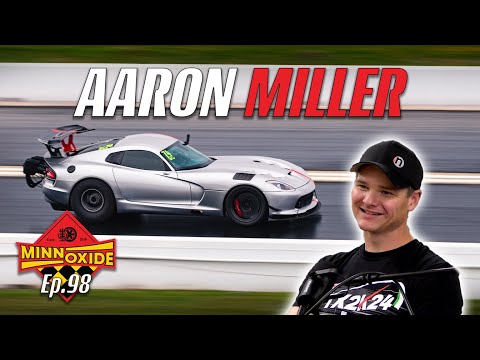
157. Nth Moto, Roll Racing and Drag Racing, Viper's and Ford GT's w/ Aaron Miller
Guest
Summary
Chapters
- 00:00 Intro
- 04:44 Streetcar Bragging Rights Recap & Roll Racing Experience
- 10:25 The Roll Race Format
- 22:43 Roll Racing vs. Drag Racing
- 30:01 Winning Factors & Kratos Setup
- 36:11 Adapting Setups for Events
- 40:48 Packaging High Power Street Cars
- 46:16 Mix of Street and Race Customers
- 56:35 Crossover Between NA and Turbo Builds
- 01:04:41 Modern ECUs & Motec
- 01:13:40 Manual Transmissions & Gearbox Development
- 01:22:20 Technical Achievements & Development Lessons
- 01:35:55 Future Platforms, Race Cars, and the Viper Niche
- 01:43:48 Ford GT Builds
- 01:53:06 Injector Choice & Fuel System Importance
Full Transcript
This episode is brought to you by the High Performance Academy. More on them later.
And it was awful to drive, awful. And the only way you were going to get around that was to have an ECU capable and a calibration that's done well enough to make all those things jive together. My car makes half that and it goes quicker. Like, yeah, it's true, it's not 2,400 pounds. It's not going 99 to 105, 60 foot. Like, it's not, it's not, it's not. They're just different.
Hello, ladies and gentlemen. Welcome back to the Minnoxide podcast. I'm your host, Harris, aka Minnoxide, man of many automotive aspirations. And I'm here with my Ford loving co-host, Dan.
Yep.
Mr. Gunnar Garage.
That's me.
Is the Ford still here or is it gone now? It just shipped, didn't it?
Yesterday. You missed it by a day.
You got a GT here?
Yeah. Yeah. Yeah.
Well, today we are here with Aaron Miller, owner of Nth Moto, which is, I think by the time this airs, should be exactly one year since our last go-around. Very cool. Funny how that timing worked out.
A little annual get-together.
I think it's a good way to go about it, annual get-togethers. But so real quick, what's new with you? For those watching video, they see the new shiny things in the background.
Our friend over here. This is my co-host or my co-guest. Sure. Yeah, I know we've got our street car bragging rights, Roll Race World Champion Trophy, which we won at the event out there at Rockingham, which you guys were at. Yeah. And so, yeah, so we won that with Kratos. And now we are tasked with the duty of bringing it back for the next event, and then someone has to try to win it from us. Oh, is that how it works? That's how it works. So, it's literally like Stanley Cup game, like we're supposed to get our name engraved in here and stuff, and then it's going to pass around every person that wins it every time.
Oh, who else is there? Anybody engraved in there yet?
Well, no, because it was the first time it was the event, first time Roll Race. So, we are the first winners of the Roll Race World Championship.
That is so much cooler.
It is really cool.
Let's kick it off with that, actually. What are your thoughts on that event?
Boy, was it hot.
It was hot. Yeah. I wore black jeans the whole weekend.
That's just a bad choice. Yeah. Really cool event, Nate. I, you know, this is actually perfect. Like, this is some of the cool factor. Like, even though this doesn't mean that much to a lot of people, like this little tag for racer, like, the sponsor ones were, like, laser engraved stainless and stuff. And you're like, wow, this is, this is nice. They put a lot of effort into making sure the racers and sponsors knew that they were appreciated for being there. And I think his emphasis to that is just, is really key, a key element to the idea, because, like, at the end of the day, if the racers and sponsors aren't there, the event isn't really much of an event, right? Right. So kind of putting that at the forefront of importance of their list, I think that was a really, really smart move by them. I, the IHRA stuff is doing the same thing right now. When you go to those races and you see, like, you know, if you're a racer, like, you get catered dinner at the night. And I mean, like, next, like, not like catered dinner here's nuts and snacks and stuff, you know, it was like chicken marsala and tenderloin and, like, different types of salads and desserts. And like, it was just, anyways, they're taking this kind of same mindset of like, hey, let's put the racer first. And it's a pretty good strategy, I think.
Well, we paid for VIP, and boy, am I glad I did with how hot it was that weekend. The AC was the only reason I'm here today. But I think it was worth it. Actually, I don't want the prices to go up. It was the worst thing ever. Do not pay for VIP. No, I definitely felt like it was, well, yeah, we had the food and everything too. I think it was pretty legit.
Yeah, they did that. I mean, the Celsius stuff that was in sponsorship there and the nice tent and booth layout next to the starting line was really great. Same thing at SCVR, we got dinner as sponsors, which was great because the race went till, I don't know, what, four o'clock in the afternoon the next day or something, like sarcasm. But I mean, yeah, when you're at the track all day and you're hot and you're working on stuff and all that, and then the fact that you could just go get dinner was quite convenient because oftentimes we forget to eat. So that was a really nice touch. Overall, really, really good. The role race in specific. I love the starting format.
Okay.
Full transparency. Like, I was involved in the questions that was happening about that, about, hey, how could we do this different? And so I talked with Nate about that before the event and that whole starting speed scenario, which I cannot take credit for the race motive guys up in the Northeast are the ones that I saw that at that event. It was like, well, this is genius. This is really, really good.
Can you explain what the format is and what's different about it? Sure.
Yeah. It's probably a good thing to touch on. So what they do is they do a radar gate at the start line. Okay. And the reason that's important is because for anybody listening or watching, like, all these role races or most of any of these role races, there really isn't very much control to the starting situation. And it would be kind of like if you could think, I mean, a role race is no different than a drag race, other than you're just starting from a moving velocity, right? Like, it's still a first to the finish line. It's still very important how quick you get out in the beginning, just like a 60-foot is in drag race or reaction time or any of those. I mean, that's where the big gains are had, is anybody that has competitively drag race knows. So, it's like if you would not really have very stringent starting line rules at some grudge race type deal or something, you know, and like, I don't know, go when you want to go, or you know, like, fine, you know, like, that doesn't work. You know, bad things happen at races when people do that stuff. So, I get it that it's supposed to be like simulated street racing, but it's also competitive to the point now that like street racing and the idea of what it was years past was a lot more like, hey, we'll just kind of like go together and like high five from across a couple lanes after that was a lot of fun, right? And then the internet got bigger and the social media got bigger and everybody got real touchy on like, if you were ever on video, losing a race, heaven forbid, you know, stuff like that. And I don't know, I just think it kind of changed the scene a lot with that. Like people were far more touchy or competitive over the stuff. And so anyways, with that, at the other role races, and I'm just not going to say event names to not alienate anyone, but like at the end of the day, there's Florida 2K, there was Texas 2K, there was Street Car Takeover, like all of them. There's either a fixed start position that you start from or a start area that you start from. And so the whole goal is like, hey, get the two cars close, be traveling near the same speed and near a certain speed that's outlined. But that's about as tight as it gets, right? And then it's just down to, I mean, if it's a fixed start position, you're supposed to hit it there. I don't think anybody does, like kind of maybe a little bit before, you know, I mean, all that stuff. And then in the start gate type scenarios, it's off a trigger light, which is great, but it's kind of hard to really quantify, like, well, did they jump or did they not? And by the time the race is over, like the decision had to have already been made. So what this does instead is it put a hard cut, like there's a fixed start position on the track, and there's a speed gate at that point that at, I think for that event, it was 50 miles per hour, or like 500, or 50.01, or whatever, you know, like a hard cut. If you're over this, it's like a red light in drag racing, like you went too soon, that's it. So people struggled with that, myself included, right? Because, and not because it's difficult to accomplish, but it's difficult to accomplish at that venue. Very, very, very short run up area. So you're trying to get cars that have various different gear ratios and all of that stuff, and you're trying to get these two cars next to each other remotely closely by this fixed start position, and neither can go over this set start speed. Well, if one guy gets out early, mathematically somebody has to go faster to catch up to them, right? So if they try to catch up, they're probably going to be going too fast. So there's a little bit of, I mean, it's a far from perfect system. But what it did do is not a single race was lost at that event in any of the role racing classes that happened, where someone at the end of the track was mad saying, oh, they jumped me or this happened or whatever. Zero, because you can't. Like, it can't be done. So all of that complaining that happens at every role race that you go to is no longer there. So now it's on the competitors to just, like, do a decent, be a kind human being job of staying close to one another and, like, try to get the start off. Now, with it being so short, that makes it hard there. If there was a longer run up area, that would be much, much, much easier to accomplish. But all that to say, I think that style of format and that rule layout, I think, with a little bit of tweaking, that can be pretty great.
So do you think that format's going to get adopted more, potentially?
I'd be surprised if it didn't.
Okay.
Do they give you, is there a buffer of, like, you know, what is it? 60 is where the hits at. If you're at 62, is it red light?
So with that, the start speed was supposed to be 40 miles per hour. And then they would put a high limit. And let's just say it was 50. I actually don't remember. And I should, because we didn't qualify with our first pass, actually, because we were like a tenth of a mile per hour too high.
I think a lot of people struggled with that, though.
They did. And because it's a start gate, it's not an instantaneous position, right? So now it's averaging that speed. So you may enter the gate, but if your car's fast, like if you enter the gate, and let's say the hard cut's 50, and you enter the gate at 48, well, the second pickup for it in that gate format, what if you're doing 60 now? So that's a little bit of the challenge with that. So they got some polishing up to do with that, which seems like he's very, very, very motivated to take that event and do a lot of great things with it. I'm quite certain that they will do that. And it's pretty cool, man. I mean, we're going to plan to be there again.
Yeah, well, they got it for the next two or three years. I think they secured a track for that event or something like that.
And I mean, I'm just being honest, like, the track was awesome, the facility was awesome, the staff was awesome, all of that was great.
But it was hot.
For a roll racing, that's a very short run-up area. Very, very difficult.
Now, there was quite of an area coming up to it, but that was slightly off from the actual track, wasn't it?
Yeah, so their staging lanes have a little dogleg in it. And like, when I looked at it in the overhead before the event, I had never been there before. I kind of wondered, like, Ali, are they going to start us back here? And you're going to kind of take a little S turn. And you might think that's impossible, but we raced at MITM the one year in St. Louis at Worldwide Technology, and that makes, like, a 100-degree turn, like, over 90 to come out, and they were having the cars do that. And then a street car takeover at Flying H, epically beautiful facility. I think we actually talked about that last time we did this. But there's a creek right behind the start line, and so their staging lane takes a hard turn to come around to. So, same thing, for the roll race there, we were entering and making a turn, then getting lined up and go. It was kind of fun, like, I was in a turbo viper, and, you know, you'd come around the corner and step a little and you'd grab it, you know, like, incredibly dangerous, probably, but it was fun. So, yeah, certain tracks have just, have a good layout for the roll race style stuff, and certain ones don't.
It's kind of, like, I don't do a lot of drag racing or roll racing, and really my only roll race experience is at power cruises, but there's a lot going on there. When you're trying to, like, figure out your speed, and I'm nervous about going over, I don't want to give anybody an excuse to be b******* at me, like you said at the end, right? So, if anything, I try and either not have the jump or be a little under.
Sure, he's not trying to get a big trophy, though.
Yeah, it's true. But it is harder than people think to keep that speed and try and figure everything else out to take off once you hit that line.
And the more complex the car is, the more difficult that becomes. And so that's part of it. That's why for the hardcore guys out there that love to hate roll racing, like I get it. Like, I mean, I prefer drag racing from a standing start. I think it's better. But our our marketplace pays attention to roll racing more. They just do. So we also can be pretty good at it. It's just a different kind of challenge. So that's why I just think that people that are a little like kind of uptight about it, like, oh, that's really, really silly. Why would you guys do that? Or, oh, you can't come from a dig. So that's why you do it from a roll.
Which, you've proven time and again that...
Yeah, the car goes 670s and weighs 3900, technically 4020 at that time. But like, yeah, it's a six second quarter mile car. Like, there's a lot of faster stuff out there in the world, for sure. Not that normally though, for stuff that like actually drives around, like casually drives around.
Well, yeah, you could take it to Starbucks. It's got AC, it's got everything, yeah.
That's all still there?
So, okay, why did you guys have success? Because it's one thing to win an event, it's another thing to win an event at an event, at a track that's new to you, because you've never been to North Carolina. Yep. Is there anything that led to that success? Is there any set up changes? We're talking about Kratos in this instance, so.
Yeah, yeah, and absolutely, we did. It was, we went into it with, I mean, everything we have learned at every past event, like we rarely ever show up at two places with the same everything about the car, right? Like we're always learning, we're always developing our cars and that car in particular further.
Whether you are new to working on cars or a seasoned shop owner at the top of their game, the High Performance Academy is where all car enthusiasts can go to expand their skill sets. If you want to learn how to build an engine, tune your car, improve your wiring or suspension setups, the HP Academy has the perfect step-by-step course for you. As a friend of the show, they provide the listeners with a special 55% off discount code that you can use risk-free on any course of your choosing. Details are in the description of the show below, or go to the partner's page of minnoxide.com. Go check it out. Let's get back to the show.
So, yeah, we concentrated a lot on some of the gear ratio stuff, as well as a lot of planning on the torque converter side of things with the automatic combination. We were a lot more spicy with throwing some nitrous at it down low. That was fun.
So you saw the wrong combination is the right combination.
Exactly. Yeah, it's a good phrase, isn't it? Yeah. But yeah, so we went into it far more fixated on like, all right, if we're going to run both styles of format, like we have to be more dedicated about it. Like we have the ability to change the car over every night. We don't love doing it. I mean, Burruss works is whatever, off. I'm trying not to swear, sorry. I mean, you guys were there, you saw, like, I mean, that's-
You guys are working on that car quite a bit. Yeah.
Well, every night, that's four hours fast, like his four hours, like mere mortals, that's like six or seven hours, probably, I don't know. But like four hours of suspension changes, converter change, we actually even played with some aero changes on the car too.
Yeah, that was most apparent.
Yeah.
Yeah. Not everybody seemed to catch on to that though. Like, I really expected people to ask, and like, didn't really get a lot of questions.
I didn't realize, because like we came, what, the day after you won.
Yeah.
So I was like, wait a second, what, that happened?
Yeah. Yeah. So yeah. And because they did the staggered, like, okay, qualifying for roll racing, then qualifying for drag racing, then eliminations for roll racing, then eliminations for drag racing. So every night, and we tested drag race the night before, because we'd never been to that track, so we came out there and we had made a bunch of changes on the car. And we did terrible. And we were very quickly humbled over the like, okay, we changed a lot of stuff and it didn't quite go like we thought it might. And what we did change worked awesome in the roll race. It was, if you pay attention to the videos that 1320 Video did on it, there's a lot of pretty cool things that you can catch and see and monitor and realize of like the way the car is behaving. And so it worked great in the roll race, and it was abysmal in the drag race. So we learned what doesn't work there.
Because you guys were kind of struggling on the drag race side of things.
Kind of.
I'm trying to be nice.
Well, I remember sitting up there, and it was late at night too a lot of the times. We were like, okay, we're going to stay up to watch Nth, and then we go and then I was like, oh, I stayed up for that?
Yeah, sorry. Trust me. It feels just as bad in the car or at the trailer. So yeah, no, I mean, they were aggressive changes. We tried a bunch of stuff. It taught us a lot. We got it figured out by the last run, and then it figured itself out so well that it broke the pinion, which I guess that was like a hooray victory, like, well, now we know, like, that was working better, harder, hooking harder, doing what it was supposed to do, and then it was a bummer.
Well, bummer, sure, but you also mentioned at the track, I think it was you that I was talking to, that's been in there since the build was completed.
Yeah, absolutely. What, four years ago now? Yeah, I don't even know. We debuted it, and it won the Florida 2K Roll Race at its debut, I don't remember.
I think it was 21, right?
I think it was 21.
Yeah, well, just pretend it's 21.
Yeah, sure. Yeah, I think, I don't know. I guess I don't remember. The trophy's up front, if you want.
Yeah, let's go around there. Do you have the big check, too?
Yeah, yeah, we do.
Yeah, you guys haven't cashed that yet, have you?
No, no. Well, Victor's broke. I don't think it's good for anything. He had to do all the paving and everything at Bradenton now, so it's a joke, Vic, relax. But yeah, it's been in there since the beginning and it's never changed. So I guess that's pretty good. And now we know what we can improve on or we do know what we can improve on.
That's one thing I was going to ask about that roll racing versus dig racing. You say you kind of prefer dig racing, but I assume that roll racing is a lot easier on the car.
I think so. Yeah.
You rarely break stuff.
In two different formats, right? Like driveline wise, it's easier on the car for most people. I think most everybody. Engine wise, I'm not necessarily sure because the scene that you guys see a lot, the scene that we're a part of this kind of silly, fast street car-ish market, or like the GTR world, the R8 Huracan world, all that stuff. What you guys are seeing is the velvet sledgehammer. That's the approach that everyone takes. Like, huh, no, no, no. I don't want to get rid of any of the things that I like, so we're going to wrap this giant sledgehammer and velvet and make it look fancy, and we're going to smack the motor with it. It's like just raw power production. And so like on the engine side, people push really hard. And that's where also people that are like very in tune with traditional drag racing models don't get it when they see these video titles of 11,000, bajillion, thousand wheel horsepower car, and it went this fast. And they're like, well, I don't get it. Like, my car makes half that, and it goes quicker. Like, yeah, it's true. It's not 2,400 pounds. It's not going 99 to 105, 60 foot. It's like, it's not, it's not, it's not. They're just different. That's all. It doesn't make either of them wrong. It's just people have a really hard time correlating it, because for you to go really fast, or like these, these roll race things, like there's a great example. Okay. So we went, I think our fastest pass at that event was 206 at Streetcar Bragging, or it's 206 something. In looking at the data of that race, the start line was not the drag strip start line. It was farther out on the drag strip. So in total, it was about 1,220 feet or so. So about 100 feet shorter than a normal quarter mile. And we're going 206. Well, that car has trapped 215 in the quarter mile from a dead stop. If people start to think about it, how fast is that car going from a dig 100 feet from the starting line? It's pretty fast, actually. Like, not 40. Right? And so when people are like, oh, you're coming through at a start, like, you should be so far ahead. Like, no, not really. So it's kind of an interesting thing to play with your brain on that a little bit. Because most people kind of think like, well, this thing is moving. So that thing that's stuck right there, like no way, you know, it shouldn't work out that way. But yeah, so to go 206 or 200 and whatever mile per hour in only 1,220 feet from a slow rolling start, that takes a lot of power, like a significant amount of power. And that's what I think people don't also, just don't necessarily get.
Like, I think that's pretty, like I've been getting really interested into the land speed stuff.
Yeah.
And so you look at like how fast some of those guys are going over the course of a mile or two or whatever it is. And it's like, well, this guy did that in a quarter and, you know, whatever.
Way faster, you know.
So it's just...
He's not doing it on white dirt.
There's that too, right?
So like, I mean, that's... And it's like, well, how much torque can you apply to the surface?
Right.
And continue to accelerate it and keep it in control, you know?
We have to think about that in the roll racing too, versus starting from where all the prep is.
So... Absolutely.
Okay.
Yeah.
Do you know why roll racing has been growing in popularity? Do you think it translate from, you know, people with high power now on the streets kind of had to transition to roll racing, which kind of made it more popular? Now you're seeing it more in a professional level? Is that where it kind of comes from, you think?
Let's roll back in history a little bit. And I'm a little bit foggy on this, but like, you guys are going to have to help me out. Okay. R35 GTRs, right? Wasn't there a big deal when those cars first came out? Like if you launched it more than X times, there was the rumor that your warranty was going to be voided or stuff like that.
We've heard that anyway.
Okay. Well, there's your answer, right? And that's my opinion, because all of a sudden all these cars are coming out that were, like we as Americans, like everything we do, apparently we just make things bigger and heavier all the time. So like now, you know, how much does the GT500 weigh?
4200 pounds.
Right. And it's like, how? How did we get here? You know, but so the cars keep getting heavier because everybody wants all the things in the car. We make them more powerful to try to counteract the fact that they're heavier, but then that's like magnitude of forces of additional strain on the driveline to get it moving from a start. And no different than your body. You know, you want to sprint from a dead stop, like takes a lot of muscle, takes a lot of energy to do that. If you want to accelerate from a jog to a sprint, you can do that easier. So, I personally think it was kind of a thing where a lot more people could do it without feeling as at risk for breaking their car. And I mean, like I can go back to my starting days in the street race stuff and having an Omni GLH or a Shelby Charger or stuff like that.
I keep seeing those in my feed, by the way. You need to buy another one. Get you another Shelby.
Yeah, someday. That car wouldn't hook at less than 60. I was dumb, right? I mean, I probably could have figured it out, but it was a lot more fun to not figure it out and just drive through it and then it was fun. So then, well, like 60 rolls was a really good spot for it. So that's what I did. So I don't know. I think that's kind of how that became a thing. And it gained popularity. And it, no, it is not as, there's a far less cost of entry to do it, right? And as cars have gotten faster, you can't run them legally at tracks that enforce normal certification legalities. So, I mean, like now GT 500 again. Like how hard is it to get one of those in the nines?
Not hard at all. It flirts with the rules right where it is anyway. There you go.
So what are you going to do? So, now GTD getting beat up by a ZR1X. I don't know what you're going to do about that. Oh, sorry.
I have thoughts on it. I'm not happy.
That was a request from the guys by the way. I mean, I thought it was a really good idea. We thought it'd be fun.
I definitely want to come back to the ZR1 topic because that's going to be an interesting market. Yeah. But, okay, what about Eighth Mile, right? Because I think we talked about this a little bit last year. Do you have any Eighth Mile competitors out there currently or not really?
I mean, we pay attention to Eighth Mile when we're doing quarter mile stuff.
Right, sure.
We need it to. But nobody that's specific to Eighth Mile stuff right at the moment.
Okay. Yeah, because I went to my first Cache at the Creek. Oh, yeah. Yeah, this is fun. And I also attended other events too. It is a good time.
Yeah.
So, and plus we've had a lot of Eighth Mile guys on the track now at this point. Totally.
Or, no, on the track. On the show at this point. Yeah.
So one question I had earlier, then. So in years prior to Rockingham this year, were you guys not doing as much setup changes in between events or like...
Correct. Yeah. I mean, we could. We did some things, but, you know, putting four, five, six hours of work into the car every night is not exactly the most, like, appealing situation. So we were able to be competitive. I mean, we, like, at 2K, well, this past year, we had the spark plug failure, but... Yeah, that was a bummer. Yeah. Year prior, like, we had... I don't remember. I think we ended up with the fastest run during eliminations. I don't remember where we placed. I think we qualified. Somebody's going to yell at me. I feel like we qualified second. I don't remember. Anyways, the... We've been able to be competitive without having to go kind of way... We haven't had to go totally into the hard part changes on the car. Sure. I think we're past that point. Like, I think we need to do that. We've learned we need to do that now to extract the full potential that we can out of the car. You mentioned 8th mile. Like, guys that are serious 8th mile racers don't have enough gear to go quarter mile. They wouldn't do that. It's a factor of guy that does quarter mile stuff and he's going to go 8th mile. Like, if he cares, he's not going to leave the same gear in it. Or he thinks he can just play and like, it'll be all right and they'll leave that gearing in the car. So yeah, so events past, we've been a little more walk the line of like, make it work and we did okay with that. If we want to try to do better, then we're going to need to be more focused.
What was the biggest limiting factor going from roll to drag racing?
Converter change hasn't been your biggest pain in the butt, right?
Converter is a big part of it. I mean, do you mean like the physical challenge or, oh, physical challenge is converter. Yeah, because trans is going to come out of the car and like that car is not, it's just nothing because it's beautiful. It's also not easy to work on. So it's not like it's a tube chassis car and you can reach into the inside of the tunnel and pull panels out and rip the trans out.
Yeah, you can take the whole panels out of the car in two pieces, right?
No, not that. So yeah, it's a real chore.
Well, let's talk packaging actually, because when we had Nathan Shaw on the show, he was talking about just how intense it is, which you guys do, right? Because you're doing all this stuff in a street car application. You're not building it from a tube chassis straight from the bottom up. How difficult is it to package these cars, the Viper especially? Because you've done everything at this point.
Extremely. It's extremely difficult. Let me back that up. Sure. It's extremely difficult, and this is going to sound maybe potentially a little bit pompous. It's extremely difficult to do it with the level of execution and the standards that everyone here has. You can do it a lot of different ways, and I'm not going to call it wrong. It's just not maybe the way that we would do it. To package, where it starts to get mind numbing is when you think about what we're not willing to get rid of. So air filters is a great example. Like how much air filter media do you need to support 1,800-ish horsepower per turbocharger on the car, right? Like a lot, where do you put it? Like if that's a five-inch inlet or a six-inch air compressor cover, how do you get that into a filter that is a reasonable real-world solution that somebody can just drive away with and you're not thinking like, oh man, I hope that thing doesn't fall off, or something like that.
Or suck into the turbo.
Sure, all that, right? So you have to start to create solutions to that type of dilemma, whereas in a chassis car or a race car, or if people just don't care, sure, it can be up out the hood, it can be way out front. I mean, there's a lot of things that you can do. But yet when you start to, no pun intended, put it in the box of like, hey, it's got to still have the, not just air conditioning, but that's a good example of course, but the air conditioning, the power steering, power steering coolers, oil cooler assemblies, air filtration, making sure you're not gonna drag lines down on the ground or like you can't have fluid lines running under frame rails. That's a big one in Vipers because people put the turbos so low, then they're like, oh, I'll just run this oil line under the frame rail. And like, okay, what do we do instead? Well, we very carefully put a hole through the chassis and sleeve it with a tube and what to weld it inside and outside and blend it. And so like, you'd go back and look and you'd never know that it was not supposed to be there. But now we have a pass through in the chassis that in a lot of cases is now stronger with, it's got this horizontal tube tying it together inside there that now we can pass all our hoses through.
That sounds very easy to do.
Yeah, well, it takes several hours to do that.
I think you just need more zip ties.
That's it, no, self tappers.
Yeah, there you go, yep, yep.
Because those, man, Milwaukee, run that baby in, you're all done. So you have to work on it again. So...
Oh yeah, let's serve a stability in mine too.
Therein lies the key, right? It's going to break. It's going to break. Like we can use the best parts that exist, and we do. We develop our own solutions because we break what people tell us is the best, right? And so like you go through that rinse and repeat and you have to start to prepare yourself mentally that we can do everything that we know to do, and someone or something can still break it. Totally. And everybody, customer and shop, have to be on board with that. Like you got to know it, otherwise you shouldn't be doing a build to that caliber of a car. My opinion of that at that point. Okay.
Well, with that in mind, I don't think you have many street car customers anymore. I think it seems like you have a lot of race customers at this point. Is that fair to assess or is it still equal mix?
No, I don't know. I would still say it's fairly blended. So we don't have very many cars that are event only cars.
Well, can we touch on that dynamic a little bit? And I know some of the stuff with your clientele is a little bit secretive. So can you explain to me how like Kratos works, for example, because you guys don't own that car, correct?
Correct. Yeah. No, that's customer owned.
Okay. So how does that, but that's your out in front, all that stuff and you're driving it all the time. Can you kind of just give us an idea on how that whole dynamic works?
Yeah, absolutely. Yeah, it's owned by a gentleman, fantastic, fantastic guy. He bought that car from the original customer that contracted us to build it initially. And he bought it and we had a conversation beforehand of like, hey, tell me about this thing. Like what does this look like owning something like this? It's like, well, you can own it and do nothing, and it can sit and be pretty and it makes a bunch of power or whatever. But if you want to race it like you have to know that it's what we've been doing is it's always on the forward run like you said, right? It's always going to be kind of that developmental piece if you want it to be. That takes a commitment from us on time and them on funding and planning and testing and racing and all of that stuff. He's on board for it helping evolve the platform further and further. And all of the tech and componentry that really is developed at that level is a trickle-down effect to the normal cars at that point in time.
What's a normal car?
Well, it's suitable to everything really. What I mean by that is. We look at things methodically, right? I think you know that already. But we've kept looking at Kratos as like, all right, we could just turn the boost up. Like, it could. It wants to. Like, the turbo system has enough air flow in it to do that. But we've continued to try to make the total system engine-inclusive better. That way, we don't have to necessarily do that. So the day that we want to, it's there. And like, who knows what will happen, right? But because we keep refining the air flow system and the engine as a whole, that tech, the valve train, the port design, even static compressions, cam theories, like all of the things that we try, then can translate to the lesser 2,500, 2,000, 1,500 horsepower cars. Sure. It doesn't mean that you just take all that and you put it over here, but it teaches you a lot too. And also maybe limitations. Like, if you were maybe concerned about a certain component in this engine that we've been using at about 2,000 horsepower, but turns out we've been able to utilize it in Kratosat 3,300 or 3,500 for a while, you go like, oh, well, then this is good for that person, right? Like, because still that person can break that, or a component can just fail, unfortunately. But at least at that point, we've vetted out like, hey, man, this has taken a lot of abuse at that point in time. We're extremely fortunate to have that relationship in that situation with the customer owning the vehicle and wanting to do it that way. And he feels fortunate that he's able to benefit from it because he's got other cars from us that get that trickle effect.
Sure. Well, it's kind of like you had the dark horse on the lift and you're like, this looks exactly like my GT 500 from the previous generation.
Yeah.
So that's also like, it's kind of like an OEM approach almost. Like how can we apply this to all the other cars?
Well, sure. Yeah. I mean, in a lot of ways, yes. I mean, because they have their halos, they have their development mules and they try and push and find out where those limitations are and then rinse, repeat, try again.
Yeah. What about, like, we didn't touch on this nearly enough last time. Your NA builds, is there any crossover between the Twin Turbo stuff and the NA projects that come through here?
Certainly.
Okay.
Certainly. Yeah. I'm just going to just say certainly and not say anything else. No.
I guess.
Yeah, I guess. Yeah. Yeah. I mean, so I, we as a group really subscribe to the theory of our turbo cars, we very rarely ever run them at over one-to-one manifold pressure to exhaust back pressure. Meaning like, so if you've got 20 pounds of boost in the intake manifold, you're measuring 20 psi in the exhaust manifold pre-turbine wheel. That is, a lot more people measure that now and that's good. They should be measuring it. You should know what that is. We tend to stop progressing on that combination once we hit that one-to-one mark. We rarely let ourselves go up and over that. If you were to do some data scouring on that, you'll find out quite a few people are fine with running at two-to-one or worse, you know? So maybe they got 20 pounds in the manifold, they got 40 in the exhaust manifold at that point. When you do that, that's when people talk about a turbo cam or a NA cam or whatever, right? But in the way that we see it and what we've tried to achieve is that if we keep that thing under that one-to-one pressure ratio, that engine does not know it's a turbocharged engine in that regard. Like the induction layout, like the intake manifold to exhaust manifold pressure ratio is not in a position that it would think it's turbocharged because it is not corked in the exhaust manifold pre-turbine wheel. So now, principles that apply to an NA car are completely applicable to that turbo engine over here, right? Sure. That's the way that we tend to try to look at things. And there's a lot of different ways to go about it and there's probably people that think that maybe isn't a good idea and they would like to do it this way and that's great too. But it works well for us. We get to run lower shaft speed on our turbochargers traditionally. You, I think you can get away with different creative turbo sizing versus engine combination at that point when the engine behaves like that. The combustion chamber is a happier place. Like it's harder to run yourself into problems like that, in my opinion. So yeah, a lot of these things that we're developing in like a car like Kratos, it's a development car, there's airflow principles that are applicable to that NA aspect at that point. And we've been doing that and we've been seeing that and that's been really, really cool.
Well, one of the things we talked about with Greg Banish when we had him on the show, I think it was, because he was playing around with straight pipe versus his jazzy cat setup. And I think it was something like for every, what was it, pound of back pressure or whatever, one PSI back pressure, it was like costing him three horsepower on his specific setup. Did you ever measure what that equivalent would look like for you or not really?
Not in a like per pound ratio layout. I just know that because of the way that we design our engines, if we go beyond one to one, if we have enough overlap in the cam profile or the timing events of the valves at that point, you're washing the chamber, right? Like there's more want for the exhaust pressure to win over the induction pressure at that point. And we don't want that because that exhaust gas is inert. The oxygen should be mostly gone at that point. So you don't want that back in the chamber. You want that out. So not so much in the aspect of like, hey, let's put these little, continually more reducer to like define what does that power change there. More like, hey, pressure bad. Right. No, do that. You know, that kind of.
Just a binary kind of answer. It's like, we don't need the specifics. Yes or no?
Yeah.
Does that make it so that a customer, if they wanted to do an NA build and then go to a turbo build, that they, you're getting a lot of the same motor aspects and adding that later is not a major change?
Good question, but no. And it'd be cool if it was, but the connecting rod that we run in the turbo motor, just plain and simple, has to endure more stresses than what in the per cylinder pressure we're making in the NA motor. So we may as well make it lighter then.
Right.
And the piston design, we may as well lighten that up and make that more applicable to what that engine is going to get used like. So, very good thought. And in principle, yes, it could play out that way. But practical and real world, we don't do that. Okay.
Do you see, again, it's only been one year, so I can only imagine how many builds you've had to commission since, but are you starting to see more people want to get some NA builds? Well, actually, forget that question entirely. I want to talk about throwing MoTeC on NA builds.
Okay.
Because there's Doug's, whatever, the red card I was recently in. Yeah. And then obviously Adam's car is an NA. What is it? This isn't a 9-liter, it's a heads cam.
Yeah, what they would call the prefix stage 2 8.4 head cam car.
What's there to be gained from upgrading a, let's call it a 10-year-old ECU to MoTeC?
Do I give the smart-a** answer or the?
Some people are screaming at the windshield.
I just want to say zero, right? Because I want to impress the point of power is not necessarily what we're after and that change.
Yeah.
But that's what a lot of people want to believe, and especially because like, oh, I spent this money, what power did I get from it?
Well, the Internet comments want power.
Of course. Yeah, no doubt. But there's other things. I understand the desire, right? But like, if the engine was calibrated well on whatever it was running on before, there isn't necessarily like the trap door is opened when you press this key over here and like all this power shows up on this different ECU. Now, if this one that you were on before was acting inappropriately or programmed poorly or any number of things like that, well then, yeah, maybe, sure, there's something to be had there. That doesn't even get into the function of aggressiveness or anything like that. But Viper is a really good example for that question largely because of what we've tried to help people understand with it, that the Gen 5 Viper runs on the same PC architecture or ECU architecture that the Gen 4 Viper was on, which debuted in 2008. Like in 2005 and 2006, there were mule cars running around with that electronics in it. Like when was that ECU, like the hardware, when was that actually produced or engineered at that point, right? Like how old is that phone? If that phone is two years old, like most people don't even have a two-year-old phone anymore now, right? Like it's like, oh, that piece of junk, you know? But like I don't use a Gateway 2000 up in my front office, you know, with the cowl background or whatever, you know?
I don't know what that is, Dan.
Oh my gosh, are you kidding? Come on, really? That's funny.
It was like in every office building ever.
It's an old computer, okay? Sure. Not as old as what, if there's a Commodore or something. I'm not that old. But nevertheless, it's better technology, faster processing speed. Like many of the same reasons that people want the latest, greatest phone is another good reason to have the latest, greatest ECU. And so when you can take something from calibration strategy and just capability, like how fast does that processor think? Like what availability of table and information is in that compared to what we think of now when we talk about an internal combustion engine? I mean, in 2006, like you were a bad mama jamma if you had 400 horsepower, right? And like now I think like a minivan has that or something today, right? So it's like that the escalation in tech has been really, really, really substantial in that time period. And so you may as well take advantage of it on the ECU side. And then you get into the like, okay, we can do protection safeties, you know, like oil pressure, fuel pressure, coolant pressure, whatever.
I think somebody commented about that. Some sort of safeties like save their...
Yeah, Doug's car, yeah, like... And that's a great example. Like, he had an oil pressure trip, so I threw the warning, well, it was calibrated to throw the warning light up, put it into kind of a limp mode momentarily, wait for that condition to clear, and then let him keep going again. And then he got a hold of me after, he's like, hey, it did this thing. And I'm like, well, you know, if all your temps and pressures were good, the goal is to make you scan all your gauges right then, right, like, okay, temps, pressures, everything's good. He has a Motec SLM shift light module, so the LED layout, I put it on full blue, as bright as it'll go when it's like a warning condition is on, and then when that clears, it means, hey, everything's fine again, you can proceed to be in a hole again. When we looked at the log, like it was just a really quick little oil pressure trip in there. It did that, like that's real, that happened. But he would have never known, he would have never seen the gauge flicker, the latency in the gauge would probably never even pick it up, right? Or like the filtering or whatever. I mean, OEMs do things so they don't freak out customers, right? It's like why do coolant temp gauges not even have any numbers on them anymore? They're just like, yeah, put it in the middle. Oh, it's in the middle, that's good, right? Like, what is the middle? Like, what temperature is that? So most ECUs wouldn't even see it. And if you have the ability to then do that and protect that owner in that case, like what if that had been more severe? What if that had been like the car was low on oil or he had an oil line come off and he's actually lost pressure now. And like it enables us to like warn him, tell him you've got a problem, get off the track, you know, whatever. I could save your engine. It has, I can assure you, it saved people an entire engine before. And then you get into traction control. That car has a sequential gearbox. So we do close control on the sequential.
Is that like a 6XD?
It is a 6XD in there. Yep. The best sequential gearbox ever.
Yeah, which that episode will air two weeks before this one.
Oh, cool. Awesome. All right, I'll look forward to that. Clay is an awesome dude, Rick, those guys that are fantastic people to work with, take a ton of pride in their stuff. I'm sure you guys saw. Oh, yeah. Like really, really good people.
Lots of jewelry in that place.
Oh, man.
Lots of them.
That's why we worked with them to do our 6060 main case. So we drew up what we needed to do for clearances for our gear set. And then we worked with Clay and said, Hey, I mean, you guys make transmission cases. Like, this is a lot easier for you than it is for us. Can we contract you to make this TR6060 main case for us? And so that's who makes our main cases.
Okay. I was going to bring it up, but I didn't want them to know you were doing transmission stuff on the side, but it's with him, so it's all right. Yeah, okay.
Yeah, absolutely.
I never know. We bounce around so many people, I'm afraid of talking to...
So like Tick Performance, which they've got... Like when I pitched that thing to Clay, like we use enough of them, right? But like Vipers, it's not as busy as other markets, you know, plain and simple. So when we talked about how to make this make sense for everybody, the plan then was like, hey, like you can sell it to Tick, it just won't have our logo on it at that point. But ours have our logo, we've got a couple other small things that are different. But that way, everybody benefits from it. Like we get what we need, he gets to make some money over there, the guys at Tick can help. And not many people had ever broken that stuff or felt the need for a main case, but we're just out in La La Land with like how heavy the cars are, how much torque they make, all that. So we just found more limitations. So anyways, that's what's in like Sal's car, for example, right? Okay. Or Eric Nobola's car. That's the one that just went to 29 in Kansas and a half mile.
I'm gonna try my best, cause these are all topics I'm gonna get to, cause these are all- Oh, okay.
We're moving around now.
They're such awesome topics, but I do want to come back to the MoTec and A car before we depart from that topic.
Sorry, yeah, good way to wrangle me back in there. I'm trying to wrangle myself here.
Okay. So it's cause it's been a reoccurring topic in the Viper forms. I'm sure that same package could apply to, I guess, any vehicle. Sure. I guess, what are the main selling points when you're trying to talk, not necessarily talk someone into it, but if somebody's interested in this, how do they justify, what is it like? 15,000, give or take five grand in each direction, something like that. How do they justify that investment over an ECU that's already been doing kind of a job, but how do they justify that leap?
Have either of you guys ever had a car that did something... Sorry, I had too long of a pause. That did something that frustrated you so much you just didn't really want to drive it.
Okay.
Have you?
Yeah. Well, I'm telling you, so as he's talking about this, I'm in this boat right now. There is a Motec option for my GT500, which you saw out there. I could spend $1,500 and have somebody tune my ECU, or I spend 15 grand, because that's what it is for that package as well, with tuning. So I'm on this fence right now. So tell me why I should go one way or the other.
I don't know if your car suffers from the same situation that some others might. And what I mean by that is, let's use Doug's car as an example, okay? So it had a nine liter stroker engine with a rowdy cam and ported heads and all this stuff from another company. And I don't like prefix that did it. Great guys, really like them. They utilize the factory PCM, which I'm so jealous that they can, because we have to try to use HP tuners and it's really not good. Sure. And they have access to the OE PCM. They calibrate it for that combination and it's kind of like a flash, call it a box tune type thing. So it probably works like pretty darn well in most people's cars, okay? And they do, like we've had quite a few through here for different service or parts or the MoTeC upgrades or whatever. You get a little bit of variance in how they drive and like kind of to be expected, right? If you get a box tune for your SCT programmer or whatever, like it only works so well on every car at that point. Doug's car had been upfitted with lightweight flywheel and clutch assembly, sequential transmission, different things. And it was awful to drive, awful, not prefix's fault. It's just the combination at that point was not good. And the only way you were going to get around that was to have an ECU capable and a calibration that's done well enough to make all those things jive together. And so we went from a car that like, we didn't even make it to the end of the road here. He was like, well, let me show you what it does. And we didn't even make it to the fourth half. And I was like, no, just turn around. It's fine. Like, I get it, like, yeah, like we'll be all right, you know. So get it back. He gets back in it. And like, now it can idle off the clutch, off the throttle and just and just drive itself through a parking lot. And like, no problem, whatever. Like, everything is better because I had the ability to tell it what I needed to tell it to get it to work that we needed it to work.
You don't use a computer from 2006, so why should you build? Why put thousands of dollars into your project only to be limited by a stock ECU that's over a decade old? Even some OEM calibrators are impressed with modern day functionality of standalones featuring advanced launch control, traction control, and of course, for those who aren't fans of unscheduled rapid disassembly, engine protection features. Go to toonbyshawnshawn.com, look at some of the plug and play kits available and various Haltech goodies you can save 5% on using code MINNOXIDE. Not a bad idea to shoot them a message either. Link in description. Let's get back to the show.
I don't know if you're in that position with the GT500 that you've done enough stuff to it that it's like not quite happy about everything.
I'm sure it would be happy. My biggest thing is I want the safety features.
That's kind of a big deal.
Like you say, you talk about all the gauges. Because I'm not looking at those all the time. It's hard. And then as you keep modding stuff, they want you to fuel pressure, oil pressure, temps. You're watching a lot of stuff. Am I supposed to watch the road or watch these 13 gauges I've got going on here? Correct.
So you want the ECU to do all that work for you at that point. And you actually want to be able to monitor it. Fuel pressure is a great example. There is no fuel pressure sensor on a Viper. So if the fuel system is declining in capacity, because it's old, fuel filter, pump, whatever, right? The stock ECU doesn't know. So what happens? Well, if fuel pressure goes down, fuel volume delivered at the same injector pulse width is now considerably less. And it has no way to fix that. Whereas we put a fuel pressure sensor on it, so we can watch that and monitor that and adjust accordingly. So there's a lot of things that you can do, that your hands might be tied. FlexFuel, you should be able to do that.
I want to do FlexFuel. It's another big reason I was looking at that.
So, I mean, to me, that's kind of like a no-brainer. I'm a nerd, and I really appreciate that stuff. But if you think about if it saves one time, if one time it saves your engine, they get paid for itself.
Right?
Yeah, it's not exactly a cheap engine in that car either.
No. No.
So...
Well, the big thing for him, too, is he does these cross-country road rallies. Some people are like, oh, just throw some methanol in there or whatever, you know?
Sure.
Sure, but then we're back at the same issue. It's like, what if we can't find that good E or whatever it is?
I tell you what, you talked about, my car works great as is, right? And even if I do the tune, it'll still work great. But the gas station anxiety is what pisses me off the most. Testing E85, finding E85, finding E93. Once you tune, E91 is now dead to me basically, unless it's even got 10% ethanol is a little bit better. I have my dad now as a modded car and he's constantly be like, can I get gas here? Can I get gas here? I'm like, dude, I told you, I need to write it down for him. Yeah.
No, I mean, those are all realities. So it's really nice when you can eliminate that out of your life. And those little things, it's like we do clutches a lot with RPS, with the carbon clutches and stuff. It's like a clutch can ruin a car. If you've got a clutch in a car that just makes you aggravated to drive it, you'll end up just resenting the car. And if your car does weird hiccups or burps or whatever, or if it's constantly giving you anxiety because you've got to plan your trip based on where can you get fuel and stuff, that's not for me. And you don't have to. Nowadays, the technology is there to be able to not have to do that.
Well, I see all these GM guys running around with flex fuel, and they're just happy rolling in anywhere. So yeah, it's hard for me to give them s*** when I do all this stuff.
You've got to keep that game strong.
I was going to say, GM is kind of killing it right now.
Yeah, they're not doing too bad.
Yeah, I know that was hard.
It's hard for me too.
It was really hard, yeah.
Look, my Dodge boys don't even make a cool car anymore. Yeah, yeah. And that's really hard for me.
We'll discuss that too. We'll see if we get to that, because we're going to Woodward next week, and I'm going to be talking to people. We'll be like, what are we going to do about the situation?
Yeah.
Well, you're the whole reason we're going. Obviously, we were initially talking about how many trips we wanted to do within a two or three week span, because Dan's got responsibilities. I actually have to do work once in a while. Oh, that's weird.
I'm bringing all my responsibilities with me, but we're making a family trip out of it.
Oh, cool. All right.
Great.
But it's like, all right, Power Cruise or Woodward, you were like, this is the topic we're discussing.
Yeah.
And yeah, so we're going to Woodward now.
Awesome.
Surprise. Awesome. But how do we get on then? I'm blanked on it. I'm giving you, oh yeah, no Dodge stuff.
Oh, yeah. No Dodge, yeah.
Okay. Well, let's bring it back to what we were talking about the 6060 here.
Okay.
You've had a lot of success with that. These are 4,000 pound cars with 2,600 horsepower.
Sometimes, yeah.
Or give or take, whatever it is. How difficult is that to accomplish? What were you doing into designing on this? Were you bouncing ideas around with that 6XV, for example? How did that process work?
As far as the transmission gear set itself? Yeah, so we tried everything that everyone made already. Okay. And some of it was really good, just couldn't quite get to where we were going, or it would be good for what we were doing, and then we're like, oh, well, now that that's good, like, you know, like, bummer. And so that just kept happening. And it seemed obvious to me that there was a demand for people to keep the cars being a traditional six-speed layout, an H-pattern six-speed layout, but be able to hold our bigger power combinations at that point. So that turned into partnering up with the gear set manufacturer is like, hey, look, we have the vehicle to destroy whatever you want to put behind it. So like, let's try that, right? Are you game? Like, we can work together and we can make this thing like be pretty awesome, because if it can survive this, it can probably deal with most everybody else's stuff at that point in time. So that was kind of the objective or the motive behind it at that point. And so with that, there's been plenty of growing pains or evolutionary changes you could say. And like anything, you know, you, okay, now it's working really well at 2000, let's try 2200, you know? And then like, well, then let's try 24 and then let's, you know? And then you've got repetition, you know, how much, how many runs cycles are we getting out of it? You've got driver input, right? Like, there's a person operating this thing, like, do, how does that impact this? And then there's calibration, because that's a big part of it. Like, I mean, people, people don't necessarily understand that when you get rid of a synchronizer assembly inside a manual transmission, you get rid of the thing that's kind of like keeping everything in jive. So now you've got a lot of opportunity for lash in the gear set and herkin and jerkin and stuff like that. And that can be circumvented largely by engine calibration. And so you kind of need to be on both sides of it to be able to get it to be as nice as what we have.
So there's no synchro in your TR6060s?
No, none.
Oh, really?
Okay.
None.
Just like a motorcycle or a semi truck or, you know, like anything that doesn't require a purse to shift. Oh, sorry, no.
Hey, I have a Tic TR6060 in my orange car, but it does have synchros in it.
Yes, yeah. And that's great. Yeah, yeah.
800 horsepower is fine.
And there's pros and cons to all of it, but at the end of the day, for the amount of performance that we're trying to achieve, the synchro is a wear item. So I just don't necessarily feel like it's the best way to go if you're kind of knowingly putting this problem back in there, and it will be a problem sometime down the road.
So you solve that issue. Does it come with its own set of issues then, or things to be aware of?
Yeah, more customer awareness and coaching, like how to drive properly, like how to properly rev match downshift. You know, that's what synchronizers do is match speed to the driven or non-driven gears at that point, and they aren't there anymore. So now you have to actually know how to rev match downshift properly or double clutch like you should, you know? Like genuinely, that's a process that a lot of people don't know. And so you kind of have to teach that.
So in a way, for those customers, you're kind of making like the perfect manual build then.
Yeah.
Is that kind of what you're getting at?
Yeah. Well, yeah, because they're awesome, because like you can drive it around, you still drive it like a normal car, like everything about it. It makes more noise when you shift the gears, you know, like real nice, solid, almost like a bolt action rifle if anybody's a weapons re kind of person. But you get the potential if you want to, to then instrument that and utilize that to where you can shift it wide open throttle without using the clutch. And that's what every fast manual transmission race car in the world does. And that's, I mean, motorcycles. There's just about nobody that doesn't have like a shift cut set up on their motorcycle or something. Like that's all normal. So yeah, it's kind of taking older tech and reinventing it and modernizing it and implementing it in this stuff.
And you said that's the set of Balzen Erich's car, correct?
Yep.
Was it, if I remember to post, did he set a record of some kind too or no?
Yeah, yeah, for shift sector, I erroneously, I hope people caught it. This is like one of the great things of like, redactions in a newspaper that nobody ever sees. But like everybody at the event was like, that's the fastest half mile world record manual transmission, blah, blah, blah. I'm like, wow, that's cool.
That's a long list of...
Yeah, it was a really a lot of, yeah, a lot of cell phones. Blue car, yeah. Yeah, and anyway, so like all this is gone. So like I, like any idiot on social media nowadays was like, oh man, we set this record, how cool. And then somebody mentioned Kevin at M2K Motorsports with their Ford GT when it went 300 in the mile. And I was like, oh s***, I'm going to text Kev real quick. He's like, hey man, what did you guys run in the half? He's like, 244. I was like, yeah, okay. My bad. And he said, he's like, hey, I know, no problem. But the next day I actually posted like, hey, our mistake, like, it is the record for the manual transmission class of shift sector, all their half mile stuff. And just had one more category category. Yeah, it became like defined to this, that, like their events, like, okay, whatever. It's really fast. Like I don't care what the asterisks you want to try to put by it. It's really fast. Yeah.
Well, it's also, it was, I think, four miles an hour off of the actual just Viper record period for a half mile, if I remember correctly.
I think that is correct. Yeah, I don't keep up with that stuff too much because we don't have too many people that are like real keyed in on the half mile stuff. Right. But yeah, I think it's, I believe it's 233.
I think that's what Calvo had.
And change. Yeah. And that would make sense. I know that there, I know the white ACR at Abilene, they went, I think Ryan Lukowski was driving it, then it went 233. I think that's what it was. Quote something. Yeah. And to my knowledge, that would be the fastest Gen 5. Right. Not Viper, but Gen 5.
Well, that was also Eric's, and I was kind of texting back and forth with him on whatever social platform nowadays. We were talking on six platforms at the same time.
Multiple conversations.
Yeah, yeah. That was his first time driving that car full tilts, too, right?
Yeah, in anger. Yeah, for sure. Yeah. I mean, he's had it for, for quite a while, maybe almost a year. I don't know. And yeah, I mean, he's driven it at like, maybe it's running 15 pounds of boost or something. And maybe he took it to 6,500 RPM or something like that.
Like really, only 1,500 horsepower.
Well, right. Yeah. I mean, actually, yes. You know, and he was like, wow, this thing's really fast. I was like, yeah, just wait. And then he sent it back here. That car used to have the factory case still. And so he sent it back here and we did the billet case in it and a couple of updates on it. Well, and then he came here. You met up with us, didn't you? Did we go to barbecue? Yes. Yeah. Yeah. Right over here when Adam came down and all that. Yeah. So, okay. Yeah. In the GTSR when we were making hits in the car, that's the first time he had ever felt that thing, like, do what it can do. And that was still kind of like a mild-ish kind of thing. Sure. So, yeah, that was like his experience as passenger at that point because I don't know who is driving. And then, and then when we went to the half-mile, which he just like sprung on us, I don't know, like a week before or something, he's like, I'm thinking about doing this. I was like, yeah, I don't know. Could be fun.
He just put the coffee down quietly like, all right, go on, see ya. Just quietly set it down.
Yeah, but no, he did such a good job in that car. Okay. That's a lot of car. And he took instruction extremely well, gave really, really, really good feedback on like what he was feeling in the car, and how it was going so that I could make changes to try to help work for him. And yeah, I mean, I think he missed 5th, the first run, because it's funny in the shift sector stuff, there's like this whole thing now between like synchronized or not. And it's like, well, no one else in the manual transmission world does that at all. Like there's no version of that differentiation, but for some reason that, I don't know, whatever, it's fine. But they, anyways, it's still a manual transmission. Like he still has to shift it, and you can still do it wrong. And he did. And he missed fifth, and it coasted, and he went through the traps at like 162 or something. And anything, his family was there, and his friends and all that. And I could kind of sense a little bit of like a, oh, like I don't know if that was really that good, right? And so like we get back and pull the data out of it. And he missed the gear change, that car goes fourth to fifth, if he's all the way out at the shift light at like 196 or something like that, I think. So he missed the fourth to five at like 183 and then coasted for like two and a half seconds or something and it went 162. So when you like context, like put that together, it's like, oh, that's gonna be fast.
It was broken.
Yeah, and so then I think his next run, I think he went to 17 on the very next run. And then-
Quite the jump.
Then missed a year again. Then I did some cut strategy changes and kind of helped coach him through some of that. And then, yeah, then he- I don't remember the progression at this point, but ultimately went into the 220s, and then the wind shifted, and dark clouds were coming, the temp fell, and I looked over and was like, suit on, like go. Like right now, get up there kind of thing. And he ran up there, we iced it up. It was a lot of fun. His wife and his son and daughter were there, and they were helping ice the car and everything. And so you got up there, and it goes to show how impactful Aero is at that level. I mean, it's got all the ACR Aero on there. And by that wind coming from broad and coming behind all of a sudden, like I did nothing different to the car calibration wise. And it went from going like 220, mid 220s or something. He nailed the shift light. I mean, like a pro on every one of the runs. It was an ideal run. And then went 229.82 or 83 or something like that. So it's pretty amazing. I was really proud of him. He did such a good job. That's a really fast car.
Well, not bad for... that was his first event, right?
Yes.
Yeah, that's not too bad coming out the gate.
It's kind of a high bar.
It's all down low.
Well, I had to tell him after, I was like, hey, you got to realize, like, I mean, so what that car makes for power and capacity, that's it. That's what it can do. And the weather was kind of just right. Like the air quality could have been better for making power. But the conditions of the wind and the way the temp came in and the track surface, all of that is like, there's not a lot to ask for to be better.
That was Indy, right?
That was in Kansas.
That was Kansas. Okay, gotcha, gotcha.
Yep. Yep. Independence, Kansas.
Oh, that's right. Okay. What does coaching look like? Like, what are these conversations you're having with, I guess, the customers?
Oftentimes, it has a lot to do with kind of like trying to get the jitters out of them. Sure. I mean, for those that haven't driven something like that, and especially not with repetition, there's a lot of things happen. There's a lot of noises. There's a lot of covering that distance and that speed. I think we've referenced this before, but like 200 miles an hour is about a football field per second of ground coverage. And so, when you're in the car, like 230 almost, I told his family, I was like, you'll see when he comes back after another run, I was like, watch his hands. And he gets out of the car and he's sitting there, and his hands are sitting there shaking. It's like, yeah, because that's what happens. It's a huge adrenaline load. And so a lot of it is kind of trying to coach through that of like, hey, you're doing a really good job, like not falsely, like telling him like, hey, you're doing a really good job, like here's what we can do. Yeah, no. Like I don't think, that's not my style. I don't think it helps. I'd rather tell somebody like, hey, man, like we gotta back it up a little bit here, you know? But he was doing a really good job and just kind of giving him the confidence that he does, he knows how to do it. He knows how to do it right. Little pointers of what to do with, I mean, even your elbow is like the positioning of your elbow in that car to shift properly. Like that's a big deal. And that's why I, that's probably why it strikes a chord for me when people try to get all uppity over this synchro or non thing. It's like, dude, if the guy doesn't move his arm, it doesn't shift. Like it's a manual transmission. Like you gotta do it. And if you do it wrong, you break the car or you ruin the run or like any multitude of things. Like there's a lot of what ifs that are still over here, right? Sequential, that's why sequentials aren't in manual transmission. That's an I pattern shifter, you know, only forward and back. And you're moving a barrel in the transmission. I don't know if you guys get into all this with clay, but they would be the ones to show you all that stuff. But that lever is moving a barrel system, which that barrel system has a worm gear path that moves the forks to where they're supposed to go. You cannot do it wrong other than just not pull it all the way or its calibration strategy of the shift cut or something like that. But there is no version of like, oh, I missed fourth. Like, nope, no, like it just, you pull the lever and it goes to fourth. So either fourth wasn't there in the gearbox or like something else happened, right? But so to that point, like there's still a lot of driver element required to do the job right in the car, whether it's got to synchronize your ring and the transmission or not.
Okay. Do you find, so this is an extreme whatever, but we'll go to a track day and sometimes my wife will join me and I'll put her in the seat and then I'll send her out there and she'll go. And I have to constantly tell her, it's like, listen, I take that corner at this speed. You need to trust your car a little bit more. Do you find yourself doing that as they're getting into something like that?
Yeah. Usually it's in the low speed stuff, right? Because it's intimidating, like, especially if they've already made a pass, right? They know what's coming, right? They know that power rush is coming on. And so, but still it's still kind of a drag race in my mind. Like, you can't eat up a bunch of distance from the start line and expect to run really fast. Like, you're shortening the racetrack on yourself. So we tend to, like, get the guys to leave and, like, launch the car. Semi-launch, whatever, like, but accelerate hard through first gear. We'll see a lot of people kind of, like, casually go through first and then, like, get into it at that point. And, like, that's cool. You can do that too. I feel like you're maybe leaving something on the table that way. But getting Eric comfortable with the idea of, like, look, let the car do its thing. Like, don't shift until that shift light comes on. Like, when that shift light comes on, you do your thing, right? But wait. And so if you listen to the video really carefully, you can hear it ride the TC, like, a little bit of wheel slip, and, like, I'm picturing it in the log, and I can, like, hear it kind of thing. Like, a little bit of slip, and it wrangles it in and pulls it in, and he drives it all the way up to the shift point. Right, 79, 80, or whatever, I think he was right. He was just shy of 8 grand on that one, and he nails the 1 to 2, and nails it on the 2 to 3. So he trusted that the car was going to manage it. He just had to steer it and keep it doing what it needed to do, is keep his foot down, hit his shift timing when he needed to, and he just did a marvelous job. So, yes, you got to kind of teach them to have the confidence in themselves and in the equipment at that point, that it can do the job you're asking it.
So you obviously have some auto setups and some manual setups. Do you have a lot of sequential stuff out there still? Because I know Adam used to have it, and now he's, you know, auto. Yep. Do you still have a lot of that out there then or?
A lot, probably wouldn't be the right word, but certainly plenty. Sure. They're awesome. Like, if 6XD makes it. Well, there's others too, but like that one's really good.
For your purposes, that seems to be the best, yes.
In my opinion, like that 6XD X unit, the stronger one, that's the Mac Daddy. It's so good.
You'll hear it in the episode when it drops. They haven't found the limit, is what he said multiple times. And he's like, if somebody's going to find it, you can ask him how that went for us before. I think we've talked about that.
I think you're the reason there is a next.
Oh, yeah, yeah. No, we've found the limit. Yeah, I mean, I say that now with a smile. It wasn't very smiley at the time. I bet. But, and not necessarily their fault, but therein again, there's a good example of setting the expectations, right? They just flat out didn't understand how much torque abuse we can put this stuff through if we want to.
Do you surprise yourself? Do you ever sit down and you call them a dino pole? No, seriously, do you ever sit back and go, holy s***?
Yeah.
I mean, does that happen every time or is that you know you've got more in stuff or?
If you asked my wife, and she's probably the right person to ask about this, one of the things she criticizes me, maybe not criticized, maybe coaches, and she's an angel to deal with me to begin with. But she always says that I never really take the time to enjoy the victories. So once we hit this achievement, or win something, or whatever, it's like 10 minutes later, it's like, okay, cool. Well, what did we learn? And what can we do better now? And here, here. So in rare instances, yeah. The first time we cleared 3000 Wheel in here on Juggernaut, that was a really, oh my gosh, just never really thought that was gonna be a thing. And now it's like, I don't wanna call it normal, but it's like, it's there if we want it, whenever we kind of want it with certain cars. So yeah, that's, I guess surprising. Yes, it is surprising sometimes, but I'm not very good at relishing in that surprise for too terribly long. So just recently, we've made some really, really incredible discoveries and changes with induction layout and cylinder head and valve train and all kinds of cool things with the Viper motor stuff, to where we're not, we haven't told anybody, talking about it yet kind of thing, we'll wait. But the engine's desire to run at an RPM range naturally, like really wanting to be there is a very new thing that we've kind of stumbled, we didn't stumble on it. But it's something we've been working really, really hard on, and it's proving itself as well worth the effort. And those things are, I really am motivated by, I think that's really cool, because it's been a challenge. And it's like, no, no, no, like stay the course, like we can do this, and there's a reason we're doing this. And then when you get to see that, like kind of proof, it's pretty exciting.
Do you have any roads you've gone down that you've had to ditch?
Oh, totally. Yeah. Oh yeah, definitely.
When do you give up? You know what breaks my heart? No, it's not the 2% female demographic. It's the fact that 80% of you guys are not subscribed and following the show. So go ahead, hit subscribe or follow. And of course, if you're on YouTube, hit that bell so you are notified when we drop a new episode. Let's get back to the show.
Ha ha ha, probably too late. Okay. You know?
Is it usually a time thing or a financial thing? Both maybe?
I probably, it's probably dumber. Equally bad, but like, it probably hurts more on the time than it does on the finances, if that sounds right. Like, nobody likes to burn money for development and get no where on it, but it's harder, like you don't get that time back. And so that's kind of a harder thing to acknowledge.
If you had focused that time somewhere else, you might have been more productive.
Yeah, but you wouldn't know, right? So like that's, and so we get that, like even what I was just talking about, this like engine development discovery that we've done here recently, it's like, man, we have other engines that we could have maybe been implementing that same change in at the same time while that car was waiting for that engine, for this or for this or this, but we couldn't do it yet because we didn't know. We thought we knew, but we didn't know, know. But then by the time we knew, knew, like, well, that car is already together now. It's like, well, do we take it back apart? Because now we know. And now we know that there's something that's missing over there. And that's where we as a group are not very good at leaving that stuff alone. So, but yeah, no, we've tried things that didn't work or tried things that, maybe a good example, that is, we did a turbo system that we, so we call, we have, like, families of our turbo systems for the Vipers, like the Delta Series, then the Zenith Series, and we, we are indeed one called the Origin Series. It's all plays on math terms of things, you know, and, but the Origin Series concept was, hey, let's, let's try to do a turbo system that isn't quite as overly engineered as, like, what we kind of do on everything else. It was based around OEM exhaust manifolds that would be modified, because they're not that bad of a piece if you do it right. And, and then the thought was like, well, we don't have to do, like, all the latest, greatest turbocharger technology. And like, well, we could do an air-to-air. And like, maybe the fuel system doesn't have to be as robust or as crazy as what we normally do. And conceptually, it was a, it was a good idea. And it worked. Like, I mean, we, we built, we built a car, we did fixture work. Like, we had all this kind of geared up as the idea of like, let's do this. But what we realized is, by the time we actually got the car done, so many times we looked at it, we're like, man, we can't leave it like that. Because like, we know we can do this better. And then like, all of a sudden, the fuel system was like, not that far off from what we normally do. Or like, we couldn't use not good turbos. And then all of a sudden, like, well, we may as well do, you know, Garrett dual ball bearing, water-cooled center cartridges, and run all the water lines like you should, and like all that stuff. Because would it have worked just the same? Yes. Would it have been what we want as representative of Nth Moto for everyone? No. And so that was the decision that we had to make then, that we basically like burned that time. So there's one out there that Ryan owns, and the car's awesome. He just, like what we told him he was gonna get, he got a whole lot more when it was done. And it turned out great, and he's really happy, and that's lovely. But we just couldn't bring ourselves to not do it as nice as-
So you toyed with the budget build basically.
Kind of, yeah. I mean, yes, price was the objective, right? And ultimately, it just felt like we were doing ourselves kind of a disservice because we knew how to build a car better than that. So do we want to? And we're really, really thankful. I'm very thankful. I'm sure everybody here is that we're fortunate that we've worked ourselves into a position that we get the opportunity to choose if we want to do something or not do something. We're not forced into like, oh, we have to offer this or something. We don't. And I actually just recently listened to something from the guys at Tin Soldiers Race Cars on their YouTube channel. Really, really, really good little workup quick where they kind of explained where they stopped, why they stopped doing customer builds and moved into parts manufacturing. And he relates it in there with his faith and talking through some scripture in there and like relaying that. And it was like, it really touched for me on a couple of things. And he made that point of saying, like, we're really so fortunate that we get to choose what we want to say yes or not to. So maybe kind of what you're saying on the surprise thing or like what I'm referencing that my wife says, like, you don't relish those victories. Like, it's pretty great that we can be in a position that I can listen to somebody say, hey, I'm really interested in this project and we can make a decision as to whether we want to or not want to at that point.
Right.
I veered a little with that, didn't I?
No, actually. I'm going to jump right off that. What's your favorite?
Yes, you've said. Oh, that's really hard.
Because they're just all knows and suck or?
No. Juggernaut's got to be one.
Yeah.
I mean, that still is probably one of the prettiest race car engine bays ever. Yes. I'm fine. I will be proud and say that. Prove me wrong. That thing is awesome.
Well, what was the question that you said yes to in that case then?
Would we do it?
Okay.
Well, what was the criteria? I had to sell the car. I owned that car. I sold it to Will and then built it into that. That was not an easy yes for me. So, I'm really glad it worked out that way. And he was the right guy for it. Right. But because that, I mean, so many great things have come out of that with our relationship with Will and Rachel. But that's probably got to be one of them.
Did he come with a, because I don't know that relationship very well. Did he come with a certain criteria? Like, I need to do this, this and this, or?
Kind of, yeah. I mean, it was like, we had built a Silver ACR already. Oh, that's right, yep, Colossus. Yeah, Colossus. I think it was a, it may have been a stock motor turbo car at that point in time still. Sure. And then he had a red Gen 2 Viper back in the day. Actually, I inadvertently saw him at Texas 2K when I was just there as a spectator walking around kind of thing. And I have this fetish for Viper stuff, and I saw it, I remember CCW SP600 wheels, and it had this side mount intercooler system because it had this really old CPE turbo kit on it and blah, blah, blah. I thought it was the coolest thing ever. He did not really like it. But anyways, he came up with this idea, he's like, man, I really want to build a drag Viper. Does that sound interesting to you? I was like, yes, I love drag racing and I love Vipers. Tell me more. And then we got talking about it and I was like, well, I happen to have this car that has a chassis already done and it's a Viper, and that would work, right? And so that's how that started.
And I also happened to do-
Yeah. So that's how that spawned. And what we had originally thought, the whole thing was if we just took what we had done with the Silver Car and done it in a Gen 2, but put an automatic and went drag racing with it, like it'd be a pretty fast car. And that was correct. It would if that's all we did. And then it went from like that to what it is, all in one fell swoop. So we went from like, hey, you know, a 1200 to 1400 horsepower turbo drag Viper might be cool, or 30, whatever, 100. That could be cool too. So it escalated very quickly.
What was the first drag Viper you guys built?
Well, that one was probably it, as far as like really dedicated at that. We had built the blue 06 Coupe. That was the first car we ever did. And that kind of transitioned into doing some drag racing. I think that happened before we did Juggernaut. I'm going to test my memory a little bit.
I'll just go through your YouTube. You have a lot of cool stuff on the YouTube. What was that? It was like a 2J-powered formula car or something.
Oh yeah, that's your local.
Really?
Yeah.
What was that thing again?
So Don Groff is a guy's name. One of the nicest guys you will ever meet. So intelligent. Really, really amazing metal craftsman. He built the whole car.
Okay.
Like the car, like the chassis, the body, the concept, the engine, like it's two 1JZ super engines that he built a crankcase for, had Scat make a crankshaft to attach them for the proper cylinder timing and all that. He cut one of the cylinder heads in half and flipped, or cut the end of the cylinder head and flipped the end, so all the cam gear, so it would be a hot V set up. So then he could run one head backwards compared to the other, so it would be like an old formula car and all that. And he just made all this stuff, you know? And it's a Corvette T56 transaxle out back. And yeah, it's epic. So we did the wiring and tuning on it. That's how we got involved with it. And yeah, it's such a cool car. And you know, you kind of think about... I mean, we dynoed it in here, right? And it was this car that was like internet legendary. Like, I mean, so many people had seen it, and then we're like, man, we're like making it run right now, you know? And stuff like that. And I remember dynoing it, and I had a helmet on because like over your shoulder is the cam gears are right there, and you're watching the belt whip around and stuff. And it didn't like connect for me until after we finished dynoing it. Because I always think, it was like, oh, man, if this belt lets go, like that'll be a real bummer, you know? So I want something there. Never did it like occur to me like, hey, this engine this guy made, like if this comes apart, like I don't know what happens, right? But it didn't, and it still hasn't. And, you know, anything, I don't remember exactly, it made over 700 wheel at like 15 pounds or something. I mean, just like, and we helped him with the turbo sizing, but he built all that stuff all on his own. And yeah, I should probably see him on Saturday, but yeah, really, really, really phenomenal, phenomenal human being, really admirable person.
I remember watching a video, I'm like, this thing's insane.
Yeah, yeah, it sounds-
I didn't know all those extra details, that's even crazier to me.
Yeah, I'll see if I can connect you guys with him. Like really just an amazing man. Built the whole thing, his shop is under his house, like it's this cool deal, it's like four car wide garage that's under. And then through that, you get into his metal workshop area. And I mean, he's got like a bridge port that's like in between the rafters and stuff. I mean, it's just like, and it's amazing. He can do some really, really amazing things. And he's got other really cool stuff too, that people, that he's built. He did a twin turbo big block Chevy in his Buick convertible that it's got like a Jag E-type style IRS in the back of it and all this stuff. And like the fuel lines, like the injector lines are all, the injector wiring is all hidden in fuel line, hard line. So you don't see the wiring going down to the port injection that he built. And I think he did all that stuff in like the, Don will need to correct me, maybe late 80s, early 90s or something. I mean, they're like Ray J turbo chargers, like old aircraft stuff or something. I mean, it's like on their off tangential T4 housings. It's all really like period old school stuff. And it's so cool.
So I fixed a windmill for my dad the other day. I welded it and there's guys doing this stuff like that.
But you felt victorious.
I was like, yeah. And then I hear that story. I go, oh.
Yeah, no, it's a neat thing. I've taken him for some rides and some of our fast stuff. And he's such a gearhead. I remember I took him in a six-speed ACR that made about two grand. And I usually ask people or I tell people like when it's like a hot run kind of thing when we're in Mexico. And I'm like, hey, if this doesn't feel good to you, like, wave me off, you know? There was no waving off from him at all. And we found another road that was across the bridge in Canada. And then I was like, you want to do it again? And he's like, hell yeah, I do. And it kind of sets in. I'm like, oh, this is awesome. So it's cool because there's so much relatability, even though our age separation is a good bit.
That's the best thing, isn't it?
It's so cool. And I look to him as a really good example of a person and things that he's accomplished in ways that he helps people now. Because he helps people with metal projects because he just wants to, when he wants to. He gets to choose to do what he wants to do. So that's a pretty good way to be in life. When people talk about what is success, I think success in a lot of ways is getting to choose what you want to do or not do.
So, okay.
Got a little philosophical there, sorry.
I'll bounce right off of that. Why Vipers? Right? We've had this sort of in the past, this discussion, but do you see yourself, again, I saw you doing the Ford GT stuff. I know you love that.
And we have to talk about that. That's another really good yes, by the way.
We forgot it last time. We have to discuss this. But why, is there any other markets you want to branch into? I mean, I know some of the stuff you design can work for other markets.
Oh, yeah. I mean, like, we can do anything.
I know you love your fair share of 2Js.
Yeah.
As any Viper guy knows.
Yeah, those are cool, for sure. The snowmobile stuff that we've been getting into with the guys at Hypersports, that's really cool. I do get a big kick out of that. That's neat. The marine stuff, we've been getting more and more involved in that. And I think that's really cool. I mean, totally hardcore as far as abuse case on engines and components, but that's cool. So I think there's a lot of neat stuff like that. But as far as car platform stuff, I see a trend with like... Viper stuff has not slowed down for us at all, even though I would have expected it to by now.
It looks full over there.
Yeah, I know.
You look busy.
Yeah. The wait time for people is getting a little like where I'm uncomfortable with it, like I just feel bad saying it. I don't know, man. We could probably look at doing that sometime next year. I don't know.
Oh, it's back to that.
Oh, yeah, for sure.
Which is a good problem to have in some ways.
In some ways, yes, but not always, right? So that is that. But there's probably going to be more race car stuff, like real race car stuff. There's a couple of projects we have coming up that will be more geared like that. And I have a feeling that when we do that, the way that I know that we can do that, that there's just going to be more that want to do it that way.
Okay, so you see a larger Viper race car market emerging then?
Oh, I didn't say Viper. Oh, okay, just a race car. Yeah, yep.
When do we get you into doing like pro mods and stuff? Do you see yourself doing that ever?
Well, those are race cars, right? Yeah.
Oh, okay, fair enough. Fair enough. I was trying so damn hard to get Adam to go on this drag and drive we were doing in April. That didn't end up happening because of weather, unfortunately.
Oh, bummer.
Weather, you mean tornadoes?
Well, minor detail.
Yeah. Yeah.
Yeah, things are going to drive around them, right?
Yeah.
Yeah. You got all the arrow.
It will work out fine.
Yeah. This is actually a question I've been wanting to ask you forever. When do we start seeing an Nth Moto drag and drive car?
Well, that would be really cool.
Because we can just stick something on the back of Adams and make it work, right?
Yes and no. Okay. Legitimately, it's a legality thing. So the cars are faster than what they cert to for legality.
Yeah.
And so if you want to go run Adams' car and go 850, by all means go for it. But I'd be bored to death on that thing going 850. And so that's kind of a hard part. And I'm not placing that as like that's a fault of the event organizers. I get it that they're handcuffed as far as what they can legally allow people to do based on the safety set up of the car. But until somebody is fine with significantly cutting up a car, that's what it's going to take.
Well, you take a lot of... Yeah, thanks for reminding me of that. Because like you... I've seen cars that have... You had to be at what, six seconds, six fifty cages or whatever? Like that's what's required for some of those, right?
Well, depending on how fast the car is, of course, right? Like that goes by basis of like, well, what's the weight versus the ET of the car? And so at a bare minimum, you would need what some people would just reference as like a funny car cage where you're going to have the big driver surround in there. And that starts at 750 certs and then gets down into 650s or stuff like that. But realistically, for most of our stuff, it's too heavy for what the certs are. There is one out there that works for it. But there again, you're going to get rid of most of the interior or you're just going to be cutting the interior up to kind of put it in so it kind of looks appropriate. Fine, like I'm all for that. You just, somebody's got to be okay with it.
I still think you get, so the guys that win that are guys like Brett La Sala and our buddy up north. It blurs the lines of race car pro mod at that point. So you're like, yeah, you can drive it on a street from track to track.
Totally. Yeah. I mean, I think a lot of those guys are pretty, getting to be a lot better realists about that. It's the Internet that won't let it go. The Internet's like, oh, I bet Brett puts 20,000 miles a year on his car. I'll text him and like, no, he won't. And he wouldn't say that either.
But it's going to be like the insurance check and like, how many miles you put on an accurate quote.
Yeah. And it's not to take anything away from the car either. It's just that's the way the cars are built. And if you want to go that fast, you have to make some compromises too. So yeah, I mean, the really high-level, fast guy, drag and drive stuff, I think a lot of those guys are starting to at least acknowledge the fact where like, hey, don't get it twisted. Like this is a race car that drives on the street, not a street car that races. And that's the truth of it. Sure. And that's going to have a different definition to everybody, right?
Well, I think too, they feel like you have to walk away from the event as the fastest car sometimes too, which I've been learning as I'm going to more of this stuff. I went to Bragg & Wrights and I was like, my car could have been slightly competitive in some of this stuff. They got classes to all this stuff, so it's not like you have to be in that class, you know? So I think I'm going to try and get to some events more this year just because I think it'll be fun to compete.
Dude, they look like a blast. I have not been on one. I definitely do want to. I would love to do it with company representation, of course, you know, because that's just the difficult part. It's like our very, very mild stuff. Like we could put, I feel pretty confident, and I don't think this is a reach. And you probably have better input to that than a lot of people because you've been in some of our cars like this. Like we could build a Viper to run 850s. And like, I don't even need a trailer. Like, I don't even know that we would have different tires. Like, I mean, if you could, if they would allow that, like it would just be like, show up, run the car, and go 850 and like, we'll go on our way now, and cruise control and air conditioning and whatever.
You're probably going to need to ship your car soon, or know somebody that will. And as someone who used to work in freight logistics, I understand the difficulties of finding reliable transport, especially when trying to make it to rallies, racetracks, or the warehouse to hide your Corvette, because you're going through a messy divorce, and when she says everything, she means everything. Anywho, Nick Shearer is the proud owner of Sure Thing Logistics. Having traveled much of the country with every type of vehicle you can imagine, he's got the experience and reliability that you want to ensure a safe journey for your pride and joy. If you want to find out what it takes to ship your vehicle, go to surethinglogistics.net, fill out the intake form, and be sure to let him know I sent you. Let's get back to the show.
And I'm not saying we would be faster or beat everyone or blah, blah, blah, or anything. I'm just saying, like, that's... We have the capability to do that, sure. I mean, people... Very few of our cars would run slower than that. The ones that are automatic-converted, and there's just very few, so...
What do you leave on the table by keeping an interior in Kratos? How much weight are we talking about?
I don't think it's really that much weight. Really? I think if you really...
Or keeping it a streetcar, I guess.
Yeah. I mean, well, that... Where's the definition end, right?
Sure, sure.
But, like...
We'll just refer to everybody's definition.
Yeah. Like, if you legitimately just, like, got the interior out of it, like, I don't know, maybe 30, 40 pounds, maybe. Really?
That's not... Okay.
Yeah, it's not. I mean, that's not... It's got carbon seats, at least.
Yeah.
But...
You guys are fans of, like, Toett, right?
Yes.
Yeah.
Yep. When they're mounted properly and everything. Sure.
We've had that discussion with people, too.
Yeah. Yeah. But... But, yeah, it's not so much that. It's the, you know, the infotainment system and the HVAC and the... Yeah, the power steering system that's on it, the 15-inch front brake rotors, 19-inch wheels, you know, like all this stuff that it doesn't need to have to do what it's necessarily doing. Like, yeah, you could definitely get weight out of it at that point if you wanted to. But I think we can achieve our goals that we're targeting without doing any of that stuff.
Sure. All right, Dan, pop the Ford question. All right, let's talk about Ford GTs. Because how many of those have you cranked out of here now? Because are those typically twin turbo builds, supercharged, both?
Both. Yeah, I mean, it depends what somebody wants to do. The most recent one that we've tried to actually do a good job of showing on social media is one for Ben out of Mississippi. And that one, he wanted to keep a blower car. And I was resistive to it at first, because I just know they're awesome turbo cars when they're done right. My opinion of right is a little different than the way most of them are turboed. But Ben was adamant that he didn't want that. And he didn't want that because he didn't want to let it snowball like too far, right? Like it was like, let's put a blocker in place, and that blocker is going to be that it's a blower car. But boy, that car, I got to spend two and a half hours in that thing just the other night, and it was like, I could have easily done that again and not been tired. Like the car rides so nice. It drives so well. It makes the most glorious sounds. It shoots giant fireballs when it shifts. Like it's just all goodness. I'm very, very, very infatuated with that thing right now. And the cool thing is we've had quite a few people with GTs reach out that are like, hey, that's like, I would like something like that, I think. And that's the reality. I don't know anybody that could drive one of those that would say that they didn't like it. That's just how good it was or is. Like the smoothness, the way that header system we designed, and the exhaust, like the sounds. You drive like a pissed off teenager. You're constantly hanging the thing at three, four grand just because it's glorious the way it sounds. And it's very loud, but it's all behind you, so I don't care. Like it's all back there, right? But oh man, it's just really good. And that thing, you know, it was lowered hard on that really awesome Olin suspension we did on it. And yeah, it just, it did everything right. It did everything right. The Ford, that era Ford GT is, for me, absolutely one of the greatest cars ever, ever. It's just so good.
Which is why you should get one of those.
Are you? Huh? I think you're, are you tearing up?
Yeah. No, you told me to ask a question. I guess, I know you had done some. I didn't know how many you were doing, or if it was an active platform, you were still...
Yeah, we love doing them when we get the opportunity to do them. Obviously, with how valuable they have become, not that many people are really that jazzed up about modifying.
Well, Vipers are so cheap, so...
Well, if you make a Viper owner look poor, there's four GTs in here.
I was fortunate when I worked for Heffner Performance prior to starting Nth Moto, we did tons of GTs. I mean, we were the guys for it. Like Jason had developed this awesome turbo kit for those things that they could be done quickly, efficiently, cleanly. They looked nice, they ran nice. It was a really good program. I'm pretty sure there were two consecutive years that we did nearly 40 a year. Like they were, I mean, they were just, they were everywhere. And we could do them in five to seven days or something. Like it was pretty straightforward. I mean, I was building five turbo systems at a time, like full long tube turbo header systems and everything. And I would get the fixture out and build five cars worth of stuff. And like they were pretty much sold by the time I was done with everything. So that was, yeah, that was a good time then.
What were you doing at, I've been meaning to ask you, what were you doing at Heffner during your period there?
So I came in there and got hired in as a fabricator. Oh, okay. And I continued with that role the whole time I was there. Ultimately, just the way the business evolved down there, I was doing all of our production and prototyping fabrication work, and then started transitioning into Jason and trusting me to start doing the engine calibration work on the tuning side of things on the cars. So by the time I left there, I was doing the fab work and the tuning work at that point, for a lot of the projects, but not all of them for sure.
So we know what goes into, we've talked a lot about Vipers then, we know what goes into that, what your sauce is basically, what does it take to make a Ford GT fast? Are you going in the motor? Do you not have to? Where's your limit at for one of those?
Good question. Yeah, I mean, they've got to, as you're probably well aware, they've got a nice motor stock, but it has its limitations, especially if it's going to be blower based. Like you get up around 900 wheel and it's kind of getting dicey, in my opinion. Also recognize they're 20 year old cars. So, I think it depends on what your definition of fast is. Putting it bluntly, if you have a Ford GT, you're more than likely in a position to make the financial decision to build the motor at the same time. And I just think that's a smarter way to do it. It protects the investment, especially when you start thinking about things like, if it breaks, what parts can you get or not get? That has a very specific dry sump oil system on there. Like, how many pans are left, or girdles, or any of those things, right? So, in a lot of ways, it's kind of like, let's put our best foot forward and fortify that stuff and make it better. The one that we did has a billet crank in it, and really good rods and pistons, and then upgraded valve train and cams, and new tensioners and chains, and all the normal mod motor stuff you would do like that. So, it had a nice motor combo.
Do anything to the block, sleeves, and stuff like that, no?
No, factory sleeve, yeah. Factory sleeve, factory oiling system, given that they're a factory dry sump car, and it's a pretty nice system. That car has our triple disc carbon clutch in there. And then, yeah, then that was that one, and got a Whipple 4.5 liter kit. I mean, admittedly, it's very overblowered, and that's, it's okay, like it's fine.
55 gallon drum slapped on top of it.
It looks cool. I mean, that was part of it, like it looks cool. Like, tell me I'm wrong. Like, it's awesome, like whatever. It, so we did that. We converted the car to drive by wire, utilizing a Motec on there. That's really cool because it looks all stock on the inside, the stock pedal still in it and all that. So we got real sneaky with all that stuff.
Well, you suppose, I suppose you bring it from an early 2000 supercar at that point to a more modern day supercar at that point.
Now we're talking. Now we're talking back to that ECU game and technology and all that, right? So now the car fires up, idles, rowdy, sounds cool, has awesome throttle response. It's a big displacement blower car that makes a 1000 wheel and I can just romp it in first gear and let the car take care of everything. And it drives just around a little, you know, like I've got just a little bit of wiggle allowed in it. You know, shifted at 8 grand, boom, big fireball out the back of the car. And like, it's just, ah, it's so good. I called Ben after I was driving around that night. I was like, dude, I'm so jealous and sad that it's leaving. Like, I'm so happy it's leaving, but so sad because it's such a cool car to get to experience and drive and vet out and, you know, learn some of the idiosyncrasies because those cars are 20 years old. There's things that don't work right on them anymore. And so we ran into something with that car on the air conditioning control, actually, that we had to get real creative about. And we were able to solve it. And that's one of the things that I value with our team so much, is that we have really smart people at all positions in here. And so when we're faced with something that shouldn't be a problem, we're smart enough that we can develop ways to figure out what it is, solve it and move forward. And Ben said something on the phone. He said, man, I'm really glad I brought the car to you guys, because I don't know that anybody else would have kept working at it to get it as good as what you guys did. And that meant a lot. And there's not a lot of better things you can want to hear from someone as a customer at that point. So it was really cool.
We also get better with every build, right? Like you've done, you probably can't even count it at this point, how many builds you've done over the years, but constantly improving. How do you get more Ford, do you want more Ford GTs in the door?
Absolutely. Yeah, as many as people are willing to send, like go for it.
And does that include, again, blower builds, turbo builds? Oh, actually, let's touch on a blower build GT.
You've done a handful of those then? Sure, yeah.
So I guess the question that everybody in Draggy wants to hear is, one, what's the highest power, one that you've put out? And what does it take to do a higher powered Ford GT? Or are they even chasing power at that point?
I don't think you're chasing power if you're wanting to stay with a blower. Like, I mean, you may have gold builds. Oh.
Is anybody really competitive with Ford GTs anymore?
Not really. Nobody really races them that much anymore. Especially not at events or anything. I think it's a great platform to do it with. You just, you've got to commit, like, financially, right?
Yeah, there's like 4,000 of them, too, so.
That said, you know, we say that. We're sitting here at this table, we're like, oh man, I mean, you've got to spend a lot of money. Like, you do. Like, what? I mean, four, 500, $600,000 buy one, probably. How much is it per Fremontay or an STO? All right. Like, they're the same money. So it's not that they're just expensive. Like, people have, like, just kind of moved on platforms, which isn't that different than the story with the Viper, right? Like, the Viper is kind of a forgotten platform, and we really kind of came back and helped revive that by injecting good thought process and practices and efforts and technology into it and made it a pretty sought-after platform now. I don't think that there's anything to say that a GT couldn't be the same thing. It's got a killer weight distribution for applying power from a roll. It's, like, the mod motor's awesome. Like, it's great. So, like, as far as, like, power potential, I mean, we made, we made two grand with those things when I was 18. Maybe not quite. But, like, I mean, back in the Heffner days, like, we did that stuff. I'm not going to say, like, everything, but we did Ray Hoffman's one-mile car back then, and that thing made, like, oh, really? Oh, yeah. Yeah, that car went 264, I think, in the half. Or, I'm sorry, in the one-mile, back when, I think, the fastest anybody had been in, like, a Lambo or anything was, like, in the high 240s or something. I mean, it was like a, you know, we dropped the nuke in the middle of the runway, like, did you guys see that? Like, we're going to come back and do that again if you want, you know? But, yeah, we did a high RPM, Mahovitz mod motor on twin-gear GT42s back then, MoTec. I mean, it was a really nice build back then, and it made a bunch of power. That was like high 1800 wheel, and I think it was in like the mid 30s or low 40s for boost or something. And like it went through other iterations after that, and I forget the details now. But yeah, that's totally plausible to be done if a guy wants to.
So the Vipers obviously have Delta, Zenith, these packages. If somebody wanted to come to you to do a Ford GT, do you have a package in mind or?
Not really.
Okay.
No.
It would just be more of like, what's the customer want? Let's build around it.
Yeah.
Okay. Yep.
And in those cases, you can kind of estimate that somewhat, but it's gonna kind of more turn into like, it's kind of time and materials-ish almost at that point. Right. Depending on, I mean, if somebody wants what we just did on this most recent one, like, well, okay, we got a pretty good recipe at that point, right? Sure. And like we've done turbo cars, but I would want to do a turbo car different today than probably the last one that we had done. And so we would make different, make changes based upon that.
When was the last turbo car?
That's been a little while now. It's like two years or something, right? Oh, it's been longer than that.
Okay.
Yeah. It's been a while.
I really hope to see some more Ford GTs in here.
What's your next biggest platform you work on other than the Viper?
Ford GTs.
Is it?
I don't know.
I mean, it might be, I mean, you do an awful lot of Vipers, right? So maybe three or four of another one might be your next biggest thing, right?
Yeah. No, I mean, that would be really cool. I would love to do that because the Ford GT community is a really awesome group of people typically too. Like they're diehard guys and they're big motorsports guys. And I like that gets along well with our personalities. But yeah, you never know. Like, I mean, there's been at least three or four inquiries in the past week. So, okay, so maybe I can tell you what it's not going to be. It's not going to be Audi or Lambo stuff. It's not going to be GTRs. It's not going to be McLarens.
Any reason why?
Or any reason why? So that's why we've asked. Yeah, it works.
There's a lot of why.
Yeah. Yeah. I mean, the Audi, the Huracan stuff, all that. Like, there's enough good people out there that do that already. I don't really see a reason to try to do anything different. It's in that realm right now. So I just don't really have a lot of desire in that. Even though we have done them, like, it just doesn't seem to be worth it. We really, when we go into a platform, we really want to try to do something different than what other people have done. And there's some people doing some really nice stuff in that market. So I look at it and go like, yeah, man, you're doing a good job. Like, keep having fun. Will Degas, I mean, great customer of ours, right? Like, he just picked up a Performante. And the amount of people that, like, assumed or were telling me or telling him, like, oh, I can't wait to see Nth Moto do it. And I thought, I'll tell people, like, no, we're not going to do it. It's not going to happen. Like, Will hasn't even asked me and he's not going to ask me because he's a friend. Because he knows that, like, I don't want to do that thing in the middle of what we're doing. Like, we got plenty of stuff to do that we do normally. Like, and he's got plenty of one-off projects that he's got on our lap. Like, that, it doesn't make sense. Like, other people can go do that. I love doing business with them. I love doing work with them. But that doesn't make sense for them or for us. So not a good fit. So that's probably the reason on those cars. GTRs, same thing. Like, I don't want to...
There's so many people out there.
Yeah.
And to do it at the level you would want to do it, it's an even smaller pool of people.
Yeah, and it'd be a tremendous amount of learning that I just don't have any interest in doing.
It's just a mod motor minus two cylinders. Yeah, right.
That's it. So, and then McLaren stuff, we have people ask about that, and I just, those cars don't do anything for me other than I think they look cool.
Let's not have that headache anyway.
Yeah. So, yeah, they do look cool. I admire the engineering, but it's not what I want to be a part of.
Do you see, now that there's some different management going on at Stellantis, do you, and I've heard rumblings, do you see a Gen 6 Viper coming? And if so, are you excited to get your hands on one?
Well, so chicken to the egg there. Like, if one were to exist, I'd certainly be interested to know about it. I think we'd kind of be foolish not to. I don't think one's going to exist.
Is there any way in your opinion I have an opinion that we can take the previous five generations or whatever.
Well, five.
Well, no, I mean, how many generations are there out of the engine? Is it still five?
Oh, well, the Gen 1, 2, 3, and then 4 and 5 were pretty much the same.
Okay, is there any way we could take what's existing and put it into a Gen 6? I mean, cause like, and maybe I should just ask people in Detroit this question, cause they know all the regulations and all that stuff to deal with, but I mean, could you see a way to keep the V10 going forward? I mean, even Lambos don't do V8s or V10s anymore.
Well, like, I don't know that I know the answer to that. Sure.
I think you change the infrastructure of it then, right? Cause, I mean, there's still is, are they doing anything else? Cause this is still a push rod, just two valve, like simple, like the GM guy just beating it to death. Is that their only, all the way up into the end of Gen 5, is that the only platform they had that was still doing push rod motor?
It's a pretty good question.
I mean, are they still doing it in a truck, or did that go to something, overhead cam?
No, well, the Hemi's are all push rod actuated, technically two valve. So, I mean, different, valvetrain architecture, highly, but yeah, that's still push rod stuff. So the Hemi line, the 5764's, any of that stuff, or the 62 Hellcat stuff. That might be it, though. Everything else might be overhead cam.
Okay.
Yeah. The Gen 6 thing, I just like, I hope people will watch this that have decision making ability. Maybe you can lean on people in Detroit, you know, whatever, but I don't see the business model for it.
That's kind of my thing, too.
I mean, I don't think Vypro was ever a money maker for them anyways, or if it was, it couldn't have been much. So there's that. Like, that company is not exactly, like, in stellar position right now, so I don't know that, like, making something that isn't going to make money is going to be high on the approval list. Maybe I'll be proven wrong. I don't know. But halo cars are meant to serve a purpose to attract buyers to the brand, right? Like, the Viper being a halo car, and you asked, why Viper, right? Like, oh, man, well, I was in the Shelby Dodges, and, like, I really wanted a neon ACR, and, like, but, because the Viper was cool, but I ain't getting a Viper, you know? Corvette brings the buyers into Chevy, right? Like, that's kind of the idea. What is someone going to go by from Dodge? Like, make a Gen 6 Viper and make it awesome, and drive people to the dealership. What are they going to go by? I mean, like, well, I mean, well, being technical, that's a Jeep, right? And like, Ram is no longer part of Dodge. Like, Ram is its own brand. So Dodge has the Durango, which has been the same car or vehicle for since like 12 now, maybe or something.
They're pretty good about beating a platform to death.
Dude, I was like, oh, whatever.
Oh, they are, though.
Hey, the Fox body. How long that was like 30 years.
It had a lot of facelifts that were pretty different.
Yeah, they always tried to make it look like it was a different car. Correct. That's what doesn't make any sense about all of this. They were able to put legs on the LX platform, and they all see the Challenger and the Charger stuff forever, and people still loved them. Now, sales finally started dwindling off at the end, like, okay, well, had a good run. But then they replace it with a car that nobody wants. Nobody is buying the new Charger stuff, and nobody is surprised by that, and probably not even the people within the company. I mean, I saw one for the first time in person in Pryor Lake, I was at dinner, and I saw an orange one sitting there, and I got to look around, and I was like, man, the car is cool. Like, the lines are cool. If this thing was like four inches lower and had cooler wheels, like, it'd be pretty cool looking. It's huge. It's massive. But nobody wants to buy what they currently can buy of that car. And I'm going to be honest, like with a with the Hurricane straight six and whatever, like, I don't think that's going to change. Like, you don't think so? I don't. I don't know. Some people.
The price is also a bit of a killer.
Well, it's huge.
Yeah, it's huge.
It's a really expensive car. And on a brand that was like had kind of associated itself with like, look how much you can get for and what you can do for fun. Like a like a Superbee or like the six four, all motor, the 392 chargers. Like there was a time when those things were like what, 40s or 50s or something.
Yeah.
I think high 30s even at one point.
And like you can't do that now.
Yeah, that was a lot of motor for that price.
A lot of fun.
It was a lot of fun. I always was kind of a little bit jealous because Mustang and Corvette and all these were kind of going into this independent rear suspension, doing all this stuff. And Dodge was still like, no, we build fricking muscle cars, man. This is raw.
Come check out my shovel.
Yeah, exactly.
Yeah.
We'll put a Hellcat in anything and just put you in all the curbs.
It's fine. Don't let me get my back hoed. I'll show you what real power is. And it was cool and it worked.
Yeah.
It's crazy how it went the complete opposite way.
I know, right?
It's literally the opposite.
I know. And sometimes, maybe that has worked in company stuff. But in the car world, that's tough. That's tough to get the swing. And then it's a double negative, because if you don't attract new buyers, which you clearly were trying to do, you have created enemies out of the previous buyers. And that's not good. So that's my point. So like, okay, so I, you know, oh, they make a new Viper and it's really cool. And like, okay, well, I don't want a Durango because that's the same Durango for the last forever and I don't want that. Okay, how about that Hornet? Nope, nobody wants that. And then this charger thing, like, yep. Okay.
Yeah, a coupe EV was not the move.
So anyways, that's my thoughts there.
So, okay, obviously we want to start wrapping up here.
Oh yeah.
I have one kind of last topic to discuss. We talked a lot about calibration. What's that?
I said, we'll see how that goes.
We talked a lot about calibration. How important is choosing the right injectors? You only use one brand, don't you?
Yeah, we use Injector Dynamics on everything. Yeah. I'm pretty staunch about that. Like, they're a good customer service company. Like, they treat you well. It's a very good product. You know what you're getting. You get the right information to go along with it, behind it. So I think that's a very, very important deal. It's not one that I'm willing to waver on at all, even when they're very expensive. So, I mean, that's... It's a great point when people... If ever people think about, like, the true expense that it takes to build these cars. I know it sounds like a lot of money on paper when people hear it. You know, when we were at 2K this last year, Peter went and asked each winner in the Roll Race, like, how much does it take to build this car? I was like, whoa, didn't expect you to ask me that, right? And like Kevin from Underground was like, a million bucks, you know? And like, it's probably not wrong for what they were talking about for the big boy stuff there. And I know it sounds like a lot of money, hundreds of thousands of dollars to do this stuff at the very high level stuff, right? But if you go look at... We're talking about Kratos, right? Like that has two rows of ID 1750s on it. Yeah, it is on 1750s. That's going to mess with people's heads a little bit when they start thinking about how much fuel flow can that actually do, but they don't know what pressure we're at. And then there's all these other questions, but so it'll be fun. But so that's on two rows of 1700s. We'll just call it freezing numbers.
So that's 40 injectors?
No, two rows. So 20 injectors total. 10 cylinders, two holes.
Okay, yeah, I got it.
And but that's $6,000 in injectors.
Yeah.
So when people are like, oh man, I can get a fuel system for two grand. Like, no, can't even get a full set of injectors. Can't do it. Sorry. Next. I think that's the craziness. So it's not crazy, but that's the reality, I guess, of what people maybe just don't know because they haven't really looked at that. So...
Finally something that takes more fuel than an RX-7. Yeah.
When we're running hard on pure 1R for when we're having fun and going racing, or use that stuff and everything, but it's not uncommon for our cars to be consuming at wide open throttle around six to six and a half gallons per minute of fuel consumption at that point in time. Holy crap. And some of the big boy stuff can be in the nines.
Big boy stuff being like Kratos.
Yeah.
That's insane. What makes Injector Dynamics the best for you then? Why are you so strict on that? Is it just the data they provide or quality?
Data is really important. Quality and consistency is really important. The processes in which they place of the engineering to the finished product, I hold a lot of value in. And so that lets me trust their product at that point in time. I got to spend some really good time talking with a very, very, very intelligent fellow lately. We've been able to connect a lot more lately and kind of helping each other on some different project information.
You're making me blush.
It's fine. Yeah, it's good. So, in our late night talks. Sure, sure. He gave me some clarity by giving me this perspective. When we were talking about turbo system data, and we don't share a lot of data with people, like so it means a lot that I'm willing to share with him. He's willing to share with us. It's really, really enjoyable. But we're talking through this, and I was thinking about this like, ah man, maybe there's a different turbo combination we could try or this compressor or this or this. And he said, he's like, man, what are you chasing? And I was like, what do you mean? Like, I mean, making things better. He's like, well, like when you look at your data, like, it's not going to get any better. So like you can change something, and it could maybe get better, but it could probably get worse because it's so good. Like you have to stop and think about that sometimes. And it was a really interesting way to look at it because I hadn't really done that before of like, yeah, maybe it is really that good. And maybe like we should kind of continue down that path rather than like, hey, let me try over here now kind of thing or something. So with Injector Dynamics, it's like the reason I was telling that story is it's treated us so well for so long. Why would I want to veer away from it? And if they're as good as they are, which they are, what am I gaining by going to something else?
That makes sense. Okay, one 30 second question, and then we're done.
Do you do, it really hasn't been that long, actually. We're doing okay.
We're actually shorter than the last episode currently. No, just because I always like asking this question. Do you do a lot of like CAD and design work yourself, or do you outsource that, or?
I do not. No, I can hand sketch stuff like a MOFO, but in my brain, I can see a lot of stuff, and that's the fabricator side of things. But no, for our actual CAD design work, other Aaron Burris here has been doing some of that lately, and then I've got a great relationship with our machinist that does most of our project pieces that we work back and forth together on that, and then another person, DJ, that we work with closely on that as well.
Okay, sure, that makes sense. See, 30 second answer.
Yeah, that wasn't too bad, right?
Well, in that case, did you want to rip the usual three?
Sure.
You get to change your answers or keep them the same.
Ooh. I won't remember what they were before. I remember some of them.
Do you personally own a Viper at all?
No.
No?
Not right now.
Okay.
He wants a Ford GT, didn't you here?
Yeah, yeah.
Yeah, right? Yeah. I have to sell four.
Yeah. All right, so at the end of every episode, we like to ask our guests to pick three cars. I need a track car, a daily driver and a show car. Yeah. I don't even remember the answers from last time.
I think I picked my Imperial for one of them last time, because I love driving that thing. I still love driving that thing. Vipers in there, I just don't know where to slot it. I don't know what you want to call it. The show car count as like I want to drive it around and just have a car that I just enjoy, and it's like really pretty. But that might be a GT at this point. I'd probably say a Ford GT, no.
Not stock?
No.
They're really, really not fun stock.
And you have no...
I mean, like, let's just be honest. I mean, it's just like, there's just nothing... I'm too far gone down that path to like be excited by 400 something horsepower. It just doesn't do it.
Okay, what would you do then?
That combo we just did on Ben's car is pretty hard to argue with. Like me being an idiot and wanting like a little bit more, like it'd be fun if we could pull it a little harder, make that blower work a little bit more. That thing's only running at like around 17, 18 pounds. So it's like living a really easy life right now.
What'd you say to Made by the way?
Made about a grand, yeah. Somewhere around there.
Okay. So blown Ford GT for a show car.
Yeah.
Yeah.
I still, the purest in me likes what those cars are for what they are. So I feel like a blower build is, it does the car justice. Yeah.
Yeah, it's fitting. Yeah, for sure. I don't disagree with that. So the right turbo car is awesome. Yes. It's not that different than Viper actually to me because like the right NA Viper is awesome. So is a turbo car. So the real solutions that have both. And we have customers that have both and that's really cool. And that's the reality is they are totally different cars. They're just both very good at different things at that point.
Okay.
So, yeah, so that show car, I guess track car, race car becomes a Viper.
Like, yeah.
So ACR, Extreme, no. I'm a drag racer at heart. So like, I mean, the Gen 2 is still super sexy to me. Like, I just still love the way they look. Maybe Juggernaut is just the car to answer because it is like, it's the ultimate, like it's so good looking and yet fast drag car. So that is still streetable. So that's cool. So I'll say that. And then what was left of Daily. Lincoln Town Car, yes. Dude, I had my grandfather's town car. I loved that thing we called it the Silver Cloud. It was like...
The Panther Platform one?
Dude, yes. Yeah, yeah. No way. It was so great.
I'm getting punked right now. No, no.
There is something about that car that's freaking awesome.
It's so good. You never feel the transmission shift, maybe it did, maybe it didn't, doesn't matter. You can't hear the engines, so it's working okay. And it just sounded beyond belief, it just rolls down the road.
We're talking like a 2000, yours was 2009, right?
Mine's a 2007.
2007?
Mine was an 2006.
Yeah. 2006 is when they changed the chassis a little bit in 2003. And then the 2006 has the tack in there, so I liked the 2006 and up. But yeah.
Okay, got it.
But yeah, and you can like, oops, I forgot to change the oil a thousand miles ago. Like, they just don't, yeah, they just keep going.
Yeah. No, they really are great. I actually, like, I really think Marauders are cool. If a Marauder rode as nice as the Town Car, which I do not know, I've never been in one in my life, then it'd be like, well, that would be really cool.
I really want to Coyote swap a Town Car. That would give you the Marauder feel in the Town Car comfort. Yeah.
I just don't need it to be fast. That's one of the beauties of it. It's like, it's like, it's not. And it doesn't matter because it like floats at 80 or 85, like nothing, and it's just like glass. I actually, 169, I mean, we're getting off topic, right? But like, it's what it's so fascinating about how, where we've evolved to in automobiles, because my 62 Imperial, my son hates riding in my truck or in my wife's charger, in his car seat down that section of road, because it's got all the, you know, it's like the perfect, the perfect oscillation of like the brake points, and it's like, you know, but I run that road in the Imperial, I don't even see the fender move. Like, it's just like perfect reflection sitting there. You feel nothing, and it just goes over all of that. Like, it never even happened. Now, is that torsion spring suspension? Is that eight inch wide frame rails? Is that 14 inch wheels with like 12 inches of sidewall? Like, it's all those things working together. But like, so we've evolved for like however many years at this point in time in technology, and I'm not sure that there's a car that rides as nice as that. You know, like that's, I mean, there probably is, but it's...
I love that. I borrowed it for a day when I locked myself out of my car, and it was great.
Oh, my Tom car, yeah.
I love that thing. The best part is he literally bought it just to get to the podcast. Okay.
I mean, I was driving my truck or my GT 500, and I don't know if you've driven through the Metro, and a lot of times I was like, yeah, podcast five o'clock. I'm like, okay, cool. That sounds like fun. I got to drive to St. Louis Park, Nope. Through the belly of the beast, 394, all that stuff.
No way.
So going through the tunnel. Well, $2,000 town car will make you happy to drive through traffic. Because you're floating through traffic, and go ahead and hit me, or if you piss me off, I might hit you.
Who knows? Let's try it out.
Yep.
Well, perfect.
On that note, any final things you wanted to touch on before we close out?
I don't think so.
We'll be back here in a year.
There you go. Maybe sooner. Who knows?
Yeah, probably. Well, on that note, where can everybody find you?
Facebook or Instagram, NthMoto, NthMoto, or our website, nthmoto.com.
I love playing Where's Waldo whenever you make your posts. Like, oh, what's hiding in this photo? Ah!
Those little Easter eggs every once in a while. We've been trying to be a lot better about our social media. So Alex Bellis has been helping us a bunch and doing photos.
He's awesome, man.
Yes, he's a great guy.
I see you personally pop up in some weird groups. I don't know what it was the other day. I was in some, it might not even have been a car one. And all of a sudden you were like commenting in the comments. I'm like, how did Aaron end up in this group? I don't know what it was. I'll have to try to remember.
I don't know. It would be funny if you think of it. Because I was like, I don't think I really use social media that much.
It's just, it's very random sometimes. And maybe it was like in a Terminator group or something. I don't know what it was.
I think it was a Terminator group.
It might have been.
You always work on quirky stuff. Well, Dan, no wait, hold on. Why am I talking to you? Aaron, thank you for coming on. And this is a blast to you again. Dan, thanks for existing. And we'll see y'all next time. That's what it was. Find you at Gunna Garage. And see y'all next time.
There, nailed it.
It happens.
Thanks again for watching the show, guys. Be sure to go into the description down below and check out all of our sponsors. They are what make this show possible. It allows us to travel the country and talk to some really cool guests. So be sure to check them out, support them just like you support us, and see y'all next time.